
On CanPL: Football is here

While football culture has long been a passion of mine, it has been largely viewed from afar and has a somewhat distant and exotic feeling associated with it.

Sure, I wake up early every weekend to watch Spurs matches, often go to pubs to meet fellow local supporters, purchase kits and scarves from the official team store, play FIFA, listen to a half dozen podcasts and engage in many online communities to discuss the latest stories. However, perhaps the greatest expression of fandom, that of partaking in match day rituals and attending matches in person, has been largely elusive.

I have had the good fortune to travel throughout Europe to watch football, and lived in Toronto for a half dozen years and attended Toronto FC matches regularly. Since moving to Victoria nearly four years ago, those experiences seemed fleeting, of a bygone period of my life, and only to be relived as a tourist or transient.

On Sunday, 28 April, the intoxicating allure of attending a football match, of experiencing and participating in the supporter culture and of being fully invested in the team on the pitch finally came to Victoria.

Pacific FC played their first match in the new Canadian Premier League in front of 5,500 supporters at the newly fitted Westhills Stadium in Langford, and it was a full on experience that one would have expected elsewhere. On a day where much of the rest of the country was digging itself out of a snowstorm, or trying to deal with ongoing floodwaters, Pacific FC played their inaugural match on a sun drenched pitch against Hfx Wanderers, a team based 4,375 km away.
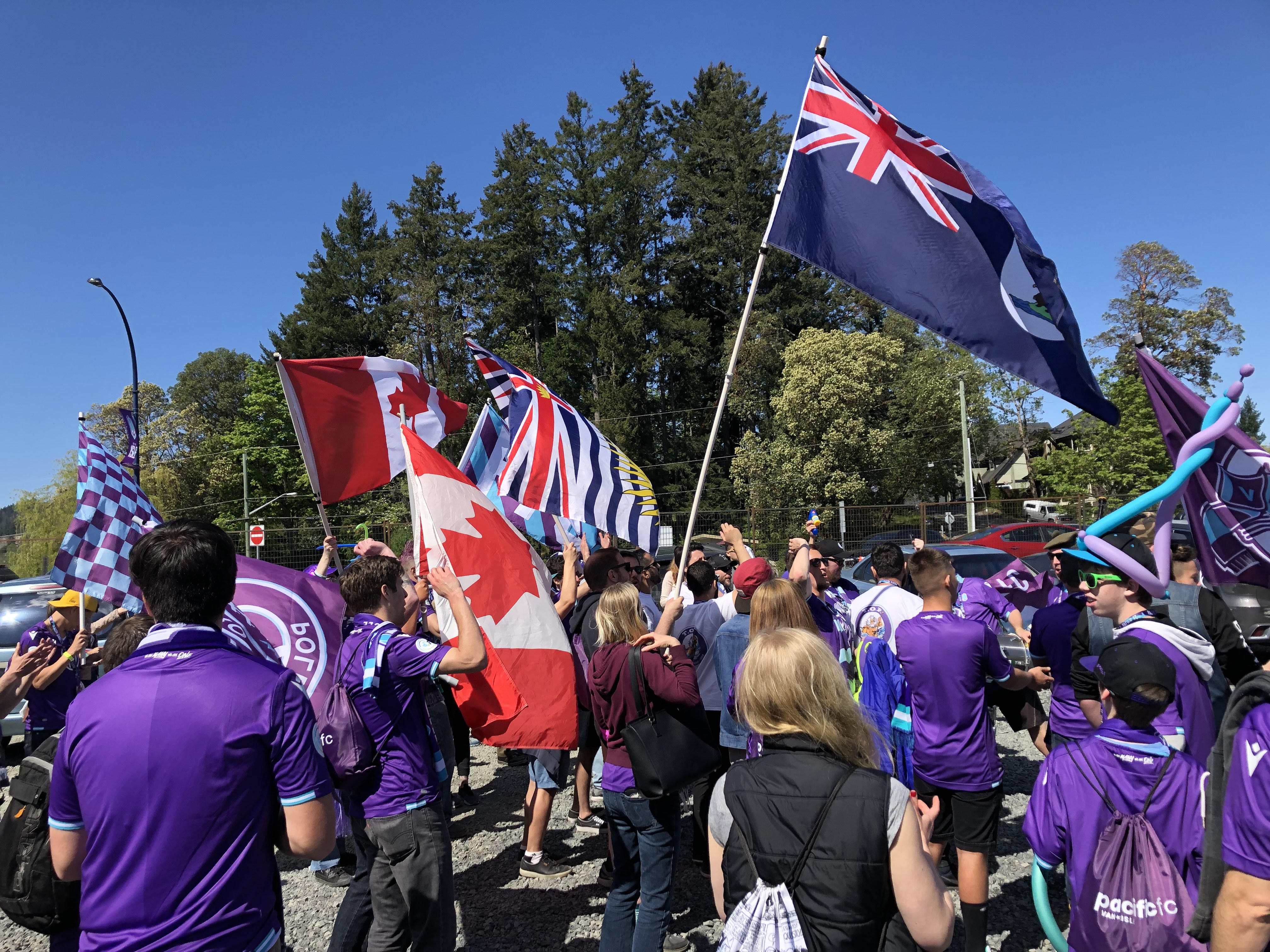
Members of Lakeside Buoys and TOP organizing for the pregame march to the stadium

Upon descending on the stadium, supporters from the Lakeside Buoys and local Brazilian supporter group, TOP, assembled in the makeshift parking lot and made a boisterous procession to the stadium, armed with drums, bagpipes, colourful flags and an army of supporters with song sheets. The swelling masses outside the stadium took notice, that this was the atmosphere to expect once inside the ground.

The stadium itself, which has been used by Rugby Canada in recent years, appeared rather unfinished, and featured a hodgepodge of different sections, all in different states of completion and purple paint cover. The main stand (the south end) featured completed purple plastic seats, emblazoned with white “PFC” text. The book ends of those stands remained incomplete, but consisted of a wooden frame and benches, and even in this state, gave the stadium a distinct West coast, forest vibe. The supporters’ end, in the stadium’s east end, also featured an incomplete wooden bleacher, while the opposite west end (dubbed the Family Zone) also featured a makeshift stand. The north area consisted of a beer garden, a VIP terrace and a congregation of food trucks. For those sitting in any of the standings, the stadium’s physical surrounds were stunning, featuring serene mountain, hill and lake views. This felt like football in British Columbia’s natural habitat. To viewers on television, surely the appearance of the stadium gave hints of a lower league ground in England. Yet, what the stadium lacked in terms of completion, it lent itself some charm, some unique character and helped enhance the atmosphere that was building inside of it.

Prior to the match, the supporters demonstrated their colourful tifos, and set off purple flares (despite the club stating before the match that these devices would not be permitted). CPL Commissioner David Clanachan was on hand at the proceedings, and did not appear to mind, and in fact seemed quite pleased by what was transpiring.

The carnival atmosphere of the pregame continued to build, and Pacific FC seemed to feed off the energy of their new home. Sitting in the main stands, the fervour in which winger Ben Fisk and fullback Kadin Chung pressed was remarkable. They hounded their opponents with vim and vigour and prevented Hfx from building up. Pacific FC dominated the early possesion.

The supporters end of the stadium continued to heave, and achieved full climax in the 23rd minute when a Noah Verhoeven corner kick met the head of Pacific FC defender Hendrik Starostzik and flew into the HFX Wanderers goal. The entire team huddled around the German defender, celebrated with an extra gusto, and gave outsiders an immediate sense of what this goal had meant. Pacific FC had its first goal in club history, and the team was off to a flying start.
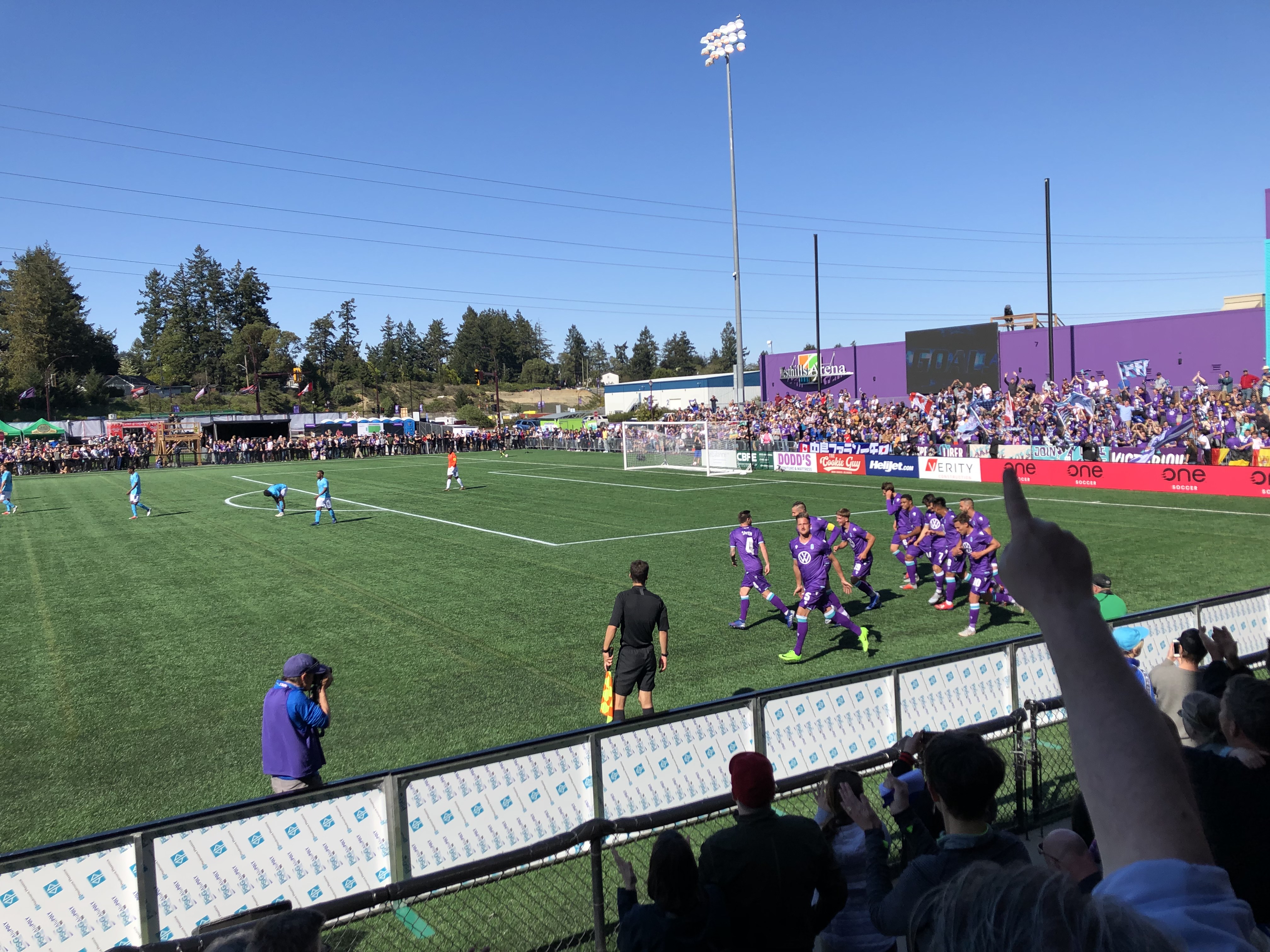

Hendrik Starostzik fires up the crowd after Pacific FC’s first goal

Hfx Wanderers thought they scored a minute later off a corner themselves, however the offside flag ruled it out.

The next flash point took place in the 73rd minute when Pacific FC centreback Lukas MacNaughton took a second yellow card, on a heavy challenge on a streaking Halifax forward. MacNaughton was sent off, and for the rest of the match, Pacific were forced to defend carefully. There was one free kick in the 76th minute fired off the crossbar, and flubbed over the goal by Wanderers’ forward Gutierrez. The rest of the afternoon belonged to Mark Village who made two key stops, and kept the first clean sheet in league history.

In the end, Pacific walked away with a 1-0 victory, captured the first victory in CPL history and went straight to the top of the league table. The team on the pitch appeared so moved by the noise that was generated, that they went to each stand applauding the fans before rollicking with the supporter section to close off the afternoon.

For those in attendance, it was a truly memorable sporting experience, and gave us a taste of what football culture is, and made us dream of what is possible for the team, the game and for all of us going forward.

Jaideep Kanungo

On Spurs: Looking back and ahead

It has certainly been a remarkable and historic past month for Spurs, one that will live long in the collective memory banks of its supporters.

This season was billed as a monumental one in Spurs’s history, as the club would return back to its home in North London, after its home matches last season were played at the relatively cavernous and soulless Wembley Stadium. After delay after delay, where more home fixtures were moved to Wembley, finally, the first match at the new Lane was played earlier this month.

The brilliant, and increasingly worthy of folk-hero status, Son Heung-min fired Spurs’s first goal in their new home on 3 April, and helped pace Tottenham to a 2-0 win over local rival, Crystal Palace. The stadium truly sparkled that evening, lest of which was the din generated by the impressive, rising Kop-like south stand. What also stood out to viewers from afar was how close to the action the stand was, and any anxiety that the team would need a transition period to discover the nooks and crannies of their new ground was quickly abated

Amidst the excitement of boasting the finest football stadium in Europe, and all its modern trappings, it was a relief to fans that it appears to have preserved the requisite atmosphere of a proper football ground. With this in hand, Spurs embarked on a trilogy of matches against England’s finest club and manager. Two Champions League quarterfinal legs, and a crucial Premier League clash would define the club’s season, and write a defining narrative in Mauricio Pochettino’s tenure with the club.

The first of the three matches was the first leg of the Champions League quarterfinal, played at the new Spurs stadium on 9 April. An immediate flash point took place early in the match, when a Raheem Sterling errant shot was blocked by Danny Rose. It all seemed quite innocuous, and there was no protestation from City, but through VAR, it was deemed that Rose had in fact blocked the shot with his hand, and City were awarded a penalty. That moment set the tone for the remainder of the tie, and Hugo Lloris’s massive penalty save on Sergio Aguero gave Spurs a tremendous jolt of belief. They fired eight shots on target in the first half, compared to City’s four, and the increasing confidence manifested in another Son goal in the 79th minute to give Spurs a 1-0 victory.

Crucially, Spurs would not concede at home, and the club left the match hoping that a semifinal berth would be possible. However, much of this enthusiasm may have been tempered as Spurs’s talisman Harry Kane lunged into a challenge with Fabian Delph, and injured his left ankle for the second time in 2019. It has become an all too familiar sight of seeing a disconsolate Kane hobble off the pitch, perched atop the shoulders of the club’s physios. Considering that Kane had just returned after a six week recovery period from his last injury in January, it was likely that he would be missed for the remainder of the season. The walking wounded tally would mount as well, as Dele Alli broke a bone in his left wrist in the final moments of the match, and the vitally important, Harry Winks, hurt his groin in training later in the week.

Spurs would be forced to rely on many of their reserves in the 13 April Premier League match at home against Huddersfield Town. With the race for the top four spots in the Premier League being separated by a handful of points, every match has proved to be a must win scenario.

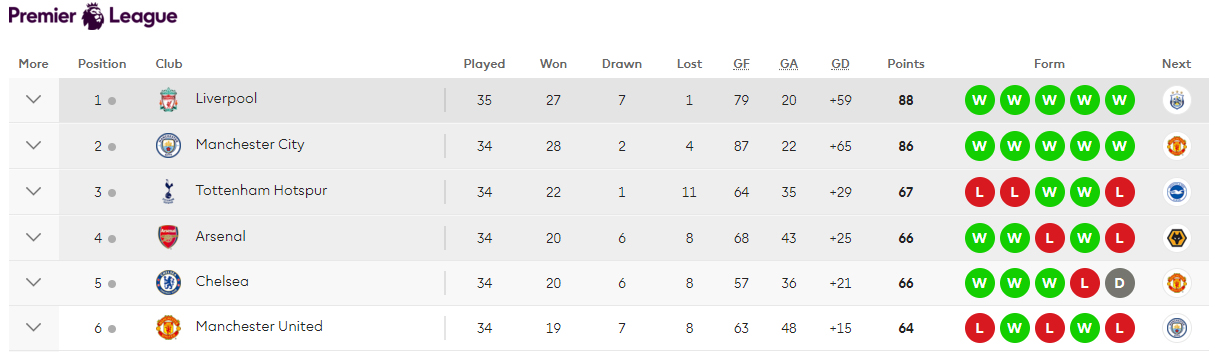
Pochettino fielded only Christian Eriksen, Moussa Sissoko and Jan Vertonghen among outfield starters who played against City midweek, and the already relegated Huddersfield proved helpless in trying to cope with Victor Wanyama and the tricky Brazilian forward, Lucas Moura. Wanyama elegantly glided towards the Huddersfield goal and slotted in Spurs’s first goal of the afternoon. Moura proved to be a dizzying force for the increasingly bamboozled Huddersfield defense, and notched a hat-trick, his first in European football. The victory kept Spurs in third position, on 67 points, with Arsenal, Manchester United and Chelsea all within striking distance to pass.

The second leg of the Champions League quarter final took place on 17 April at the Etihad Stadium, and after 96 minutes of pure exhilarating, pendulum-swinging, heart stopping football, Spurs came out on top, and incredibly have a Champions League semi-final match against Ajax to look forward to. Without Kane or Winks, the prematch expectation was that Pochettino would bunker down, play with defensive graft and set up to spring Son Heung-min on leggy counter attacks. An away goal would force City to score three, and many prognosticators felt that even with City at their devastating best, that would be a difficult task.

Within the first 21 minutes, that purview of expectations for the match went out the window. Sterling put City up within four minutes, and Son then replied in the seventh minute, and put Spurs into a dream like state when he scored his second in the tenth. Bernardo Silva would score a minute later, and then Sterling scored his second on a brilliant cross from the genius, who hardly featured in the first leg, Kevin De Bruyne, in minute 21. It was 3-2 City, and suddenly the pendulum had swung back in their corner. The goals came at such a frenetic pace that it was difficult to process who truly had the upper hand, and who was leading the tie through aggregate.

Moussa Sissoko, who has proven to be one of Spurs most vital players this season, was turned inside out by De Bruyne, and seen clutching his groin as the Belgian wizard waltzed by him. It was only the 40th minute, and Sissoko could no longer continue. As the Spurs’s bench became increasingly thin, Pochettino curiously put out Fernando Llorente to replace him, and dropped Dele Alli (who himself was recovering from his hand injury) to play deeper in Sissoko’s role. This switch further deepened Spurs’s supporters sense of angst. Lloris was forced to make a series of impressive stops early in the second half, including a ten-bell left handed punch out of a De Bruyne missile. De Bruyne, ever so dangerous (which raised the obvious question of why Pep Guardiola was reluctant to use him in the first leg), sashayed through the Spurs defense, and found Aguero who scored a trademark, near goal, tight angle finish to put City 4-2 up with a half hour to play.

If this result held, City would have gone through, but in the 73rd minute, it was Fernando Llorente who put his hip (or hand?) on a corner, which found itself in the back of the City goal. Even with VAR, it was difficult to determine whether Llorente got his hand on it, and the goal was given. The gap was closed to 4-3.

Not surprisingly, as the match neared its end, the drama ratcheted up. The climax took place in the 93rd minute. The normally calm Eriksen, was harried and pressed by three City attackers, and made an ill-advised back pass, which caught Ben Davies out of position. The ball was flicked by Bernardo Silva, onto the foot of Aguero, over to Sterling, and behind Lloris. Guardiola, Sterling, and the entirety of the Etihad crowd broke out into sheer pandemonium, as the Spurs players crumpled to the ground. It was 5-3 City. However, technology once again turned the tide of a tie, and deemed that Aguero had been offside upon Silva’s slight flick. The goal was overruled, Spurs had a reprieve and another chance at life, and the full time whistle eventually blew without further incident. Spurs’s dreams of a semifinal, the first for the club since the 1962 European Cup, became a reality.

Given the theatre and drama of the midweek match, it would have been unfair to expect that the Premier League match back at the Etihad, three days later, on 20 April, could live up in terms of drama and memorable moments. Like in the quarterfinal, City took the attack immediately to Spurs, and like they did midweek, scored in the first five minutes. Once again, it was the brilliance of Bernardo Silva and Sergio Aguero, who found the head of City youngster, Phil Foden, who put Guardiola’s boys up 1-0. Despite the obvious importance of the match, for City’s title challenge with Liverpool, and in Spurs’s need to remain in the top four, the match really did feel like an anticlimax.

After generating a couple of terrific counterattack opportunities through Son and Eriksen early in the match, Spurs were quite listless, drained of its energy and emotion, attacking impetus, and creativity in the second half. City would claim the three points, and left Spurs with another loss (their fifth in eighth matches, since the first leg of their Champions League round of 16 match against Dortmund).

As we approach the final month of the season, Spurs are in a dog fight on two fronts. Thankfully, the results at other grounds appeared to have helped their cause after this past weekend.

Battle for top 4 (www.premierleague.com)

In the Premier League, while Spurs dropped three points, this past weekend saw Arsenal lose 3-2 to Crystal Palace, and Manchester United lose to Everton 4-0. Additionally, Chelsea drew Burnley 2-2 on Monday, 22 April.

Four matches remain for Spurs, and three of those matches are at home (Brighton tomorrow, West Ham on the weekend, and Everton in the final matchday of the season). They will also travel to the Vitality Stadium to face Bournemouth. This is in contrast to Arsenal, who has only one remaining fixture at the Emirates (v Brighton, with away matches to Wolves, Leicester and Burnley). Chelsea, after their draw to Burnley, travels to Manchester to face Manchester United, and will host Watford and travel to Leicester. Manchester United has the toughest schedule, set to face City in the Manchester Derby, Chelsea and then relegation bound Huddersfield and battlers Cardiff.

An unexpected Champions League run to the semifinals against giant killers, Ajax, will also preoccupy Pochettino’s list of concerns in the final weeks.

What may prove to be Spurs’s undoing is the mounting injury list, which now features not only stalwarts in Kane and Winks, but also the versatile Sissoko, who Pochettino has concerns for after his groin injury in the quarterfinal. Hugo Lloris, also missed the most recent City match after a mild injury, and his status remains uncertain. Pochettino also will miss the service of star man, Son Heung-min in the first leg of the Ajax semifinal, as he is suspended (for innocuously tugging on De Bruyne’s shirt half way through the second leg of the quarterfinal).

The last month has provided supporters of Spurs with many incredible indelible moments that we will surely not forget any time soon. As with football and sport at large however, memories only remain forever lasting if the season ends on a positive note.

Much remains to be written, but given what is at stake for a Spurs club that has been playing an increasing number of important games in recent years, surely an exciting denouement is expected.

Jaideep Kanungo

Friends with Opinions Podcast: Episode 17 and 18

I had the opportunity to speak with good friend Ahmad Ghahary on his excellent Friends with Opinions: A Hockey Podcast. We recorded two podcast episodes this week.

In Episode 17, we discussed the results from the 2019 NHL Draft Lottery, which saw the New Jersey Devils win the first overall pick for the second time in three years.

https://anchor.fm/friendswithopinions/episodes/Episode-17-Friends-with-Opinions—NHL-Draft-Lottery-e3mq8o/a-a1ptlh

Episode 18 was recorded on the eve of the 2019 Stanley Cup Playoffs, and we attempted to preview most of the series in our irreverent styling.

https://anchor.fm/friendswithopinions/episodes/Episode-18-Friends-with-Opinions—NHL-Playoff-Preview-e3n1e0/a-a1ptlh

Please listen and subscribe to the podcast. I hope to join Ahmad for more podcasts in the weeks to come!

Jaideep Kanungo

On CanPL: Pacific FC Kit Launch

It was a day long anticipated, ever since that sun drenched day in Vic West last July when Pacific FC was announced as one of the inaugural clubs to join the Canadian Premier League.

In unveiling the club’s intention to join the new league, Pacific FC also released its unique and eye catching colour scheme (officially titled Van-Isle purple and Blue Lagoon through a well written, corporate-speak press release) and introduced us to its sharp new emblem.

The release of the official kit however would have to wait. The kit has a special place amongst football fans. It is something that is immediately identifiable, one that we can touch, feel and proudly wear whether at a kick about or at the pub. It is the physical embodiment of our support for a club. Ever since the league was announced, speculation amongst kit nerds ran rampant over customary discussion points such as what the primary colour would be, would there be hoops or a sash, which manufacturer would provide them and who the shirt sponsor would be. Many fantasy iterations were dropped by the talented army of graphic designers that populate the nether regions of the Canadian Premier League online forums.

Then, finally (!) came the day of all days. Thursday, 4 April. The league and its kit supplier, the Italian company, Macron, held a league-wide simulcast to release the kits, to fervent fan fare in all seven CPL cities.

The sense of excitement was genuinely palpable at the Pacific FC’s club shop, which was impressively filled to the gills with supporters who purchased inaugural season memberships. Club owner Josh Simpson regaled the assembled mass about the design process, on how he traveled to Macron headquarters in Bologna over several days to design the kit, and on how he attempted to reflect the island’s colour palette and include elements that would allow his players to maximize style and comfort.

After a pep rally type address from the club’s Communication Director, Mira Laurence, the kits were finally unveiled. Simpson stood beaming like a proud father as players Marcus Haber and Issey Nakajima-Farran walked out onto a runway to model his shirts. The crowd at the shop gasped when the shirt was first shown on the screen, and continued its oooohhhs and aaahs once the kits were wheeled out in the shop for closer inspection.

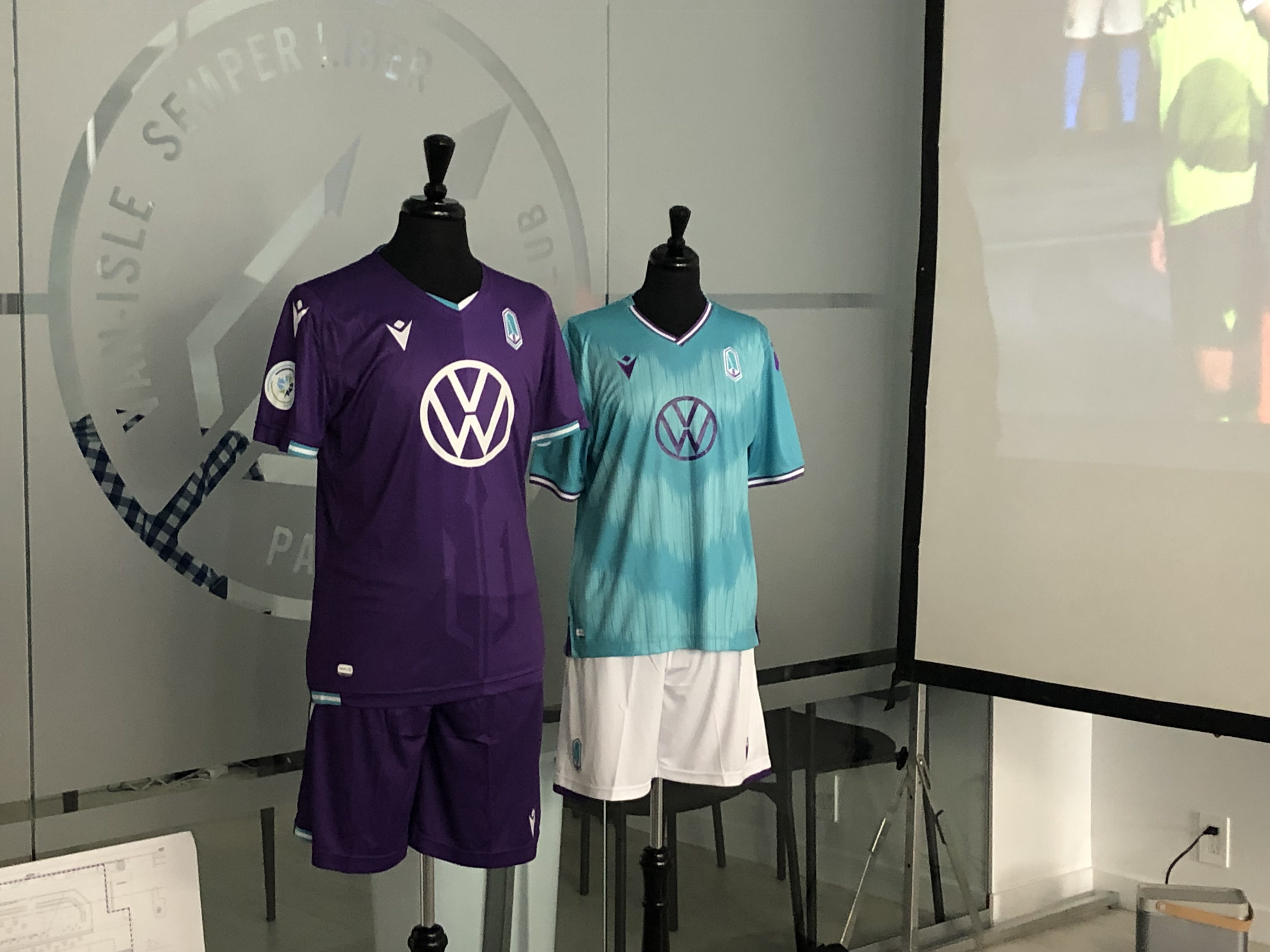
Pacific FC home and away kits, 2019 season
Pacific FC away kit, 2019 season
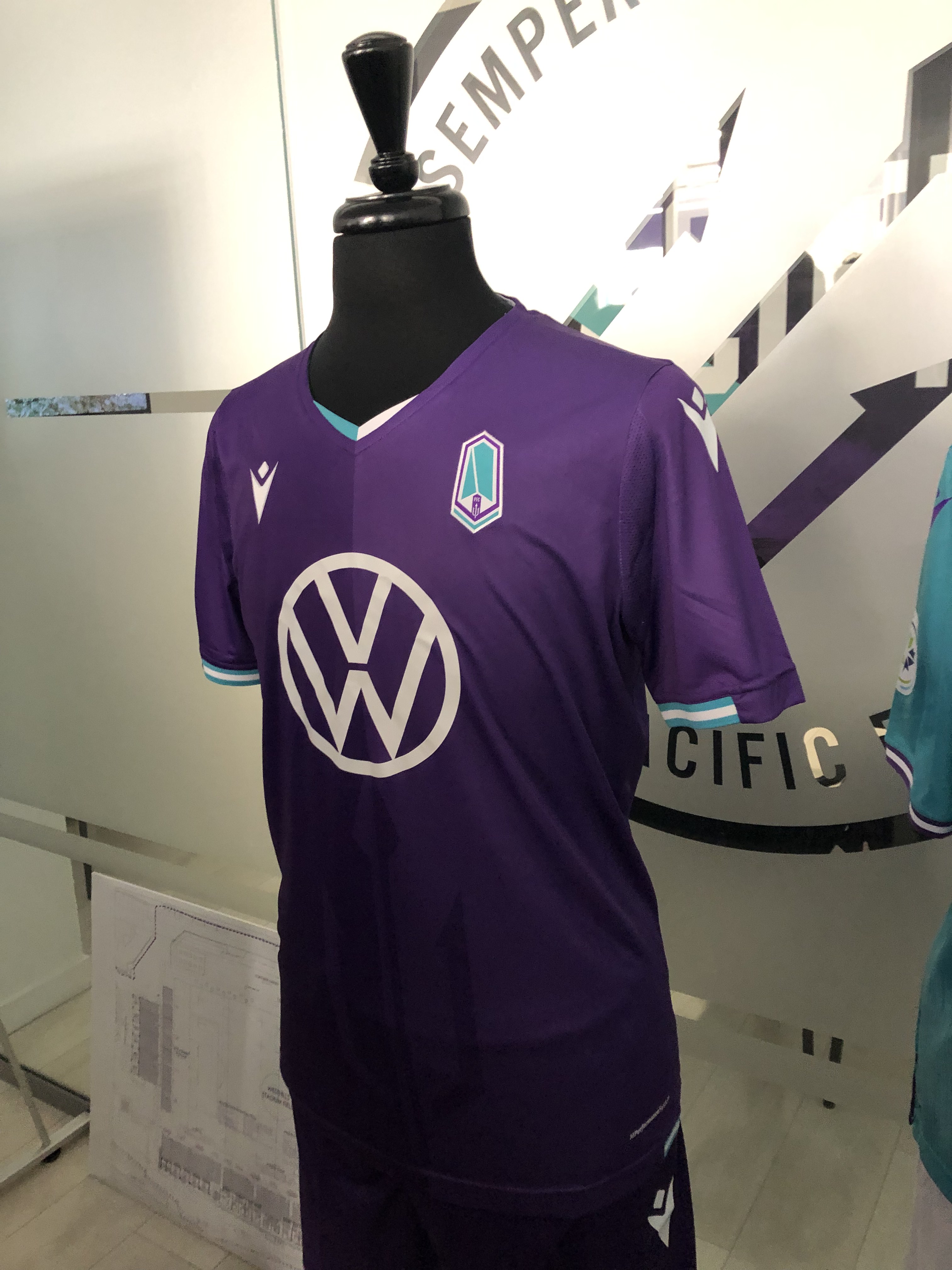
Pacific FC home kit, 2019 season

The immediate sartorial reviews were quite positive. The home kit, features a majestic purple colour, and displays a two tone design, divided by a sublimated trident, an already established element of the club’s iconography. The kit also uses a modern, athletic neckline, which displays the clubs other colours, white and teal. Simpson himself said for him while he played, this style of collar provided the most comfort and function. The unique colour scheme of the kit was one of the standout features. Few clubs in the world wear deep purple as a primary kit colour, and for this reason alone, this kit feels like a must have item.

The away kit appears quite bold, showing off a bright teal colour as the base, with a deeper teal in wavy patterns, to represent the club’s link with the Pacific Ocean. In world football, few teams feature such prominent use of teal, and the design hearkens back to German National Team alternate kits at previous World Cups (1994 and 2018 come to mind).

Overall, as a keen observer of football culture and design, for me these initial kits seem to hit the mark, and will be part of my own personal summer wardrobe. The one critique that the shirt seemed to receive, particularly amongst members of the local supporters group, the Lake Side Buoys, was the presence of Volkswagen as the primary club sponsor.

Though VW has a long history of supporting football around the globe, its most recent emissions scandal has rankled residents of Vancouver Island, who have long been champions on raising environmental issues and being amongst the most progressive in this regard in all of Canada. For a club that is trying to ingratiate itself with the entire local community, and truly be #ForTheIsle (as their corporate designed hashtag suggests), this appears to be a misstep. Surely, this will also be a point of derision from opposing fans, and will undoubtedly prompt the club to find another shirt sponsor in year two.

However, for a brand new club in a brand new league, in year one, it just may have to do.

After the event, I had the opportunity to share my thoughts on the kits with fine fellow, Adam, from The (excellent) Young Gaffers podcast. Please have a listen to the episode, and subscribe to their show!

The Young Gaffers: Episode 171: The Kits Are Here!

Jaideep Kanungo

On Canadiens: Season is over, but the world is not

When Charlie Lindgren stopped Kasperi Kapanen on the final shot, in the final shootout in the final Canadiens game of the season, there was an immediate sense of exultation and joy amongst the players on the ice at the Bell Centre clad in red, and the millions of Canadiens fans in the stands and watching on television. After all, it was a Canadiens victory on a Saturday night, against the hubristic, self acclaimed “dynastic,” rival Toronto Maple Leafs.

Yet, the thrill of the victory was not in celebration of what was hoped for days earlier, that of confirmation that the team had qualified for the playoffs. No. Rather, the jolt of excitement came from the way this team played, a genuine, helter skelter, firewagon hockey, and for the hope for the future that this team promises.

The game on Saturday night was a thrilling game from start to finish, as the Canadiens traded goals with the Leafs all evening, and where the staunch defensive hockey that the Habs valiantly played over the last month of the season was quickly abandoned for a crowd pleasing, back and forth game of shinny.

No player shone more brightly on that stage, than a youngster from Minnesota playing in his first NHL game. Signed a week earlier to the Canadiens, Ryan Poehling remarkably became the sixth player in NHL history to record a hat-trick in his first NHL game, and capped the historic evening off with a shootout winning goal. The game also marked the final broadcast of the venerable 50 year career of Hockey Night in Canada announcer Bob Cole. Imagine that for a debut; four shots, four goals, in just over 11 minutes of ice-time, on a Saturday night on one of hockey’s grandest stages, broadcast to an entire country and narrated by one of the game’s most legendary voices.

These scenes would not have been fathomable, given the despair and emptiness that resulted from the Columbus Blue Jackets’s win in New York against the Rangers the night before. That result knocked the Canadiens out of the playoff race, and stripped the Canadiens-Maple Leafs’ Saturday night tilt of all of its pomp and grandiosity.

The day Poehling signed with the Canadiens, there was much fanfare and discussion as to whether he would feature in any of the Canadiens games this week, against Tampa Bay, Washington or Toronto. These were do-or-die games, and given how coach Claude Julien stresses the importance of having all four lines contribute, how he emphasizes conservative and disciplined hockey, it was seen as highly unlikely that a raw rookie like Poehling would feature in these “playoff-like” games. Marc Bergevin essentially quashed any notion that Poehling would feature in these games on the conference call in which he discussed the signing.

Thus, it was the Canadiens’s elimination on Friday evening that allowed Poehling to find himself centering the Canadiens fourth line on Saturday night. The Canadiens also rested Carey Price, who started 26 of the Canadiens last 27 games, and played Charlie Lindgren in goal for the first time this season.

It would have been conceivable for the crowd and the team to come out flat, having had their hearts ripped out from their chests less than 24 hours earlier. But after trailing 2-0 early in the game, Poehling’s first goal late in the first period piqued the Bell Centre’s interest. His second goal, in the second period, turned the mood into a more festive one. As the teams traded goals back and forth, and the Leafs held a 5-4 lead in the third, it was Poehling’s hat-trick which sent the crowd into a near delirious state.

From then on, every time Poehling touched the puck, there was an audible murmur, a palpable sense that something would happen. And so when the Habs and Leafs were tied after three shooters in the game’s final act, the shootout, the crowd was stirred into a frenzy when Poehling skated towards centre ice to take the Habs’s fourth attempt. Poehling slalomed down the ice, and fired a sneaky wrist shot past Leafs netminder Frederik Andersen to put the Canadiens up. Lindgren would stop Kapanen, and skate to the Canadiens bench in sheer bliss, as the team and crowd around him exploded with the genuine ecstasy of victory.

After the celebrations on the ice wore off, there was a bittersweet sense to the evening. The Canadiens have missed playoffs in recent years, and in the most recent seasons in 2012, 2016 and 2018, the team was reduced to playing meaningless games for over a month. The atmosphere grew near hostile each of those years, as a series of players who have never been heard from since (Mike Blunden, Petteri Nokkelainen, Darren Dietz, John Scott), mindlessly skated out the season for the sake of filling a lineup card. When those seasons ended, there was a sense of gratitude that fans could move on with their lives, rather than consecrate two and a half hours nightly to such dross and pointlessness.

Yet, in spite of missing the playoffs in back to back years, last night, there was a genuine sense of sadness. This team was one that had expectations of being a lottery team at the start of the season, and there was extreme fan resentment towards Marc Bergevin for his work over the last three seasons, and even Carey Price and Shea Weber felt some wrath for their enormous contracts. Bergevin and Julien’s messages about the team lacking “character” last season (which were cited as a major reason for why they missed the playoffs) were largely derided and mocked by those that felt they were out of touch with the sophistication of the modern game.

However, after 82 games, there is a sense of sadness because this edition of the Canadiens actually did have a lot of “character.” They were resilient throughout the season, were one of the top 5 teams in “5 on 5” situations all season, and played fast, exciting and up tempo hockey. Furthermore, there were glimpses of how this team has some legitimate pieces for the future, whether it be Jesperi Kotkaniemi playing with the Habs, Alexander Romanov playing as an 18 year old in the KHL, Nick Suzuki dominating the OHL and now Ryan Poehling, who put on an unforgettable show in his first NHL game.

In the end, the Canadiens missed the playoffs despite finishing the season with 96 points. Only two teams in NHL history have had more points and have missed the playoffs. Both the 2014-15 Boston Bruins and 2017-18 Florida Panthers missed the playoffs with more points, and ignominiously failed to make the playoffs the following year as well.

Ultimately, there is no guarantee that the Canadiens will make the playoffs next year, despite all their youth and all the promises that youth brings. But, what this year’s Canadiens did provide was a lot of fun for its fans, and an ounce of hope for the future. In the end, those are just some of the reasons we watch the game, and that’s not a bad mindset to go into the summer with.

Jaideep Kanungo

On Canadiens: In appreciation of Artturi Lehkonen

To the casual, box-score observer of the Montreal Canadiens, Artturi Lehkonen is a player that does not generate much discussion or buzz. As the Canadiens performance this year continues to surprise skeptics, the players who the casual observers have credited for this success have been Carey Price and Shea Weber (for the usual good reasons), Max Domi (leads the team in points, with 71), and Brendan Gallagher (leads the team in goals, with 33).

Of course, for the lazy pundit who clearly has not watched nor followed the Canadiens much this season, this would be a quick way to draw conclusions and move on with the discussion. But this approach really undersells the great performances of other players, including Philip Danault, who is turning into Patrice Bergeron-lite for his ability to play against opposition top lines, Tomas Tatar, whose defensive prowess has been a revelation for Canadiens fans in addition to his offensive production, and Paul Byron, who has been an effective Swiss army knife, that can play any role for the club and that keeps opposition defenders on edge with his speed and smarts.

Artturi Lehkonen is another player that belongs on that list of unheralded, but incredibly important players for the Canadiens. A quick glance at his statsheet shows rather modest, if not unimpressive, offensive numbers. Through 80 games, his 11 goals and 18 assists, ranks him 11th on the team in points (although his 29 point season is a career high). Additionally, Lehkonen has gone through crippling slumps this year. Prior to his goal against San Jose on 7 March, Lehkonen went 29 games without a goal. Prior to his assist against Tampa Bay on 2 April, Lehkonen went 27 games without an assist. NHL players that go nearly two months without goals or assists surely find themselves out of the lineup at one point or another, yet Lehkonen has played every game this year, and continues to earn the trust of his coach Claude Julien.

The value of Artturi Lehkonen comes from his ability to forecheck and his overall pitbull like tenacity to harry opposition defenders. When the Canadiens have been at their very best this season, they have succeeded at playing an aggressive “press/reload” style system. The major tenets of this system include 1) having the forecheckers win the puck back as quickly as possible or forcing the opposition defenseman to make an errant pass, 2) having the Canadiens defensemen step up in the neutral zone to cut off the puck carrier, or errant pass and 3) having the original forechecker skate back as quickly as possible to provide cover for the defenseman that has stepped into the neutral zone. This system requires intelligent and speedy forecheckers, who have the commitment and fitness to be aggressive in two directions.

Claude Julien has likely pointed to Artturi Lehkonen’s style of play as the style he would like all his forwards to play, and it becomes immediately apparent why. Lehkonen has been the embodiment of an aggressive, intelligent, and diligent forechecker, who even through his many offensive lulls, is still contributing to the team’s system and success, by winning offensive zone turnovers and wearing down opposition defensemen. Even as the Canadiens have gone through their own slumps as a team this season, where the energy level to keep up with the physical demands of this system have waned, Artturi Lehkonen was still exerting his influence.

Lehkonen started the season playing mostly with Jesperi Kotkaniemi and Joel Armia to form a Finnish trio, however as his offensive outputs declined, he was placed on the fourth line. Yet, Julien never took him out of the lineup altogether, and even mired in slump, in which he scored only once in 34 games, Julien promoted Lehkonen to play on the left side with Max Domi and Andrew Shaw. Since this change, which took place on 16 March against Chicago, Domi and Shaw have been able to spend much more time in the offensive zone as Lehkonen has provided much more stability. Additionally, in the nine games since this line was put together, Lehkonen has scored three times. Again, the numbers are not overwhelming, but the impact on the team’s overall play has been, as the Canadiens have been 6-2-1 during a stretch in which the club has been fighting for a playoff spot. Irrespective of where Lehkonen has played, he has put together a 53.5 CF% this year.

Lehkonen’s overall value was demonstrated on Tuesday night, when the Canadiens played arguably their best game of the season against the league’s best Tampa Bay Lightning, who have put together a 60 win season. The Canadiens played with a ferocious pace, outshooting Tampa 45-24 and controlling 85% of the high danger shots. It was Lehkonen who broke the game open with an impressive display of hand eye coordination in the third period, to put the Canadiens into a 3-2 lead. His laser eye perception was on display for Max Domi’s 4-2 goal, in which Lehkonen found a streaking Domi in an area of the the ice that no Tampa defender could cover. That goal brought the Bell Centre to life, and kept the Canadiens playoff hopes very much alive.

It is truly a cliche that hockey is a team game, that the best teams must have all 19 players dressed contributing something positive on the ice. At the end of the season, when the hockey pundits look at the Canadiens successes in the 2018-19 season, Artturi Lehkonen’s name will not register in the conversation. However, let’s be quite clear, his effort and persistence all season is a major reason for why the Canadiens are where they are now, and those that truly recognize how this underdog team got this far will recognize that Artturi Lehkonen has been an integral piece.

Jaideep Kanungo

On Canadiens: Water level rising

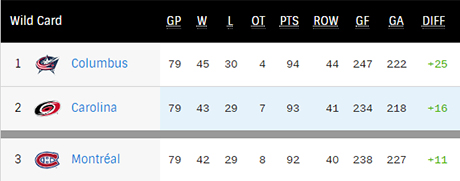
Standings after games played on 31 March (source: NHL.com)

Following an impressive win against the Winnipeg Jets on Saturday night, the Montreal Canadiens sat back on Sunday and watched both Carolina and Columbus play their games in hand. The Blue Jackets cruised to an easy 4-0 win in Buffalo, while the Hurricanes were defeated by the Penguins 3-1. The three teams are now all at 79 games, with a race to the finish in the final week ahead.

Columbus remaining games: 2 April: v BOS, 5 April: at NYR, 6 April: at OTT

Carolina remaining games: 2 April: at TOR, 4 April: v NJ, 6 Apr: at PHI

Montreal remaining games: 2 April: v TB, 4 April: at WSH, 6 Apr: at TOR

A glance at the above suggests that the Canadiens have the toughest schedule, with all three opponents this week being playoff bound opposition (whereas Columbus’s only playoff bound opposition is Boston, while Carolina’s lone playoff bound opposition is Toronto). With the Canadiens being behind in points and not having the tie-breaker (fewer regulation and overtime wins), this will prove to be an uphill climb. They will need to win every game, and will also need to rely on some help from the out of town scoreboard.

It will be interesting to see whether Tampa, Washington and Toronto (if it gets that far) will offer the Canadiens any breaks? Tampa’s star defenseman Victor Hedman was injured on Saturday night after a collision with Washington forward Carl Hagelin. He has a history of concussion, and given that Tampa Bay is running away with the league, it may be of no benefit for them to play him the rest of the week. Additionally, Tampa Bay plays Ottawa tonight (1 April) before playing the Canadiens 24 hours later. Andrei Vasilevskiy will start against the Senators, meaning that the Canadiens will likely face back up Eddie Pasquale. The league’s best team is offering the Canadiens as good of an opportunity to beat them as one would get.

Washington is close to securing the number one seed in the Metropolitan Division, as they sit three points above the Islanders, and should they seal that before Thursday night, they may also field an experimental lineup against the Canadiens.

Toronto is also locked into a first round matchup against the Boston Bruins, thus may not have the desire to field their strongest lineup on 6 April. However, given their recent drop in form, perhaps that game will be a final chance for Leafs head coach Mike Babcock to tinker with his squad and enter the playoffs with a positive mindset. They may also play with the great pleasure of knocking the Canadiens out of the playoffs. Given how poorly they have played down the stretch, and their recent history against the Bruins in the playoffs, it may prove to be their main highlight of the season.

It will prove to be an exciting final week of the regular season, and whether the Canadiens manage to get in or not, they certainly have surprised us all in playing meaningful games this late into the season.

A couple of other notes in anticipation of tomorrow’s game:

  • Jordan Weal has been a significant player for the Canadiens since his acquisition at the trade deadline on 25 February, from Arizona (was acquired for Michael Chaput). In 13 games with the Canadiens, Weal has recorded 8 points and has helped stabilize whichever line he has been on. Playing with Jonathan Drouin and Joel Armia on Saturday night against Winnipeg, he helped generate 4 of the Canadiens 9 high danger scoring chances, and was close to 60% in the faceoff circle. He has also been an important player on the powerplay. This has proven to be one of the best trade deadline acquisitions, and will be interesting whether the Canadiens bring him back next season, for his ability to adapt into any offensive or defensive situation.
  • Jesperi Kotkaniemi, who was scratched on Saturday for the third time this season, was placed on the left wing of Nate Thompson. Given how well Weal has integrated into the team, and how important he has been in faceoffs and defensive assignments, it will be interesting to watch how much Julien uses Kotkaniemi in the final week. Surely a place on the 4th line (at wing, no less) will rankle some feathers in the Canadiens fan base.
  • Paul Byron, who was concussed against Florida last week and missed the last two games, skated on Thompson’s right side. His return to the lineup will be important, given his speed, his versatility and his role on the penalty kill (which the Canadiens did not require once against Winnipeg, as they took no penalties!)
  • Canadiens signed both Ryan Poehling and Cayden Primeau to entry level contracts yesterday, after both players were knocked out of the NCAA tournament. Poehling’s ELC will kick in immediately, and as a result he burns one year of his contract, which was beneficial for him (and was probably one of the reason’s he signed). Marc Bergevin was asked whether Poehling will play this week for the Canadiens, and the impression was that he would likely only play if the Canadiens fell out of the playoff race. He is in Montreal to soak up the professional hockey environment. Primeau meanwhile will have his ELC kick in for next season, but he has a PTO with the AHL Laval Rocket for the rest of the season. The Canadiens have a glut of young netminders (Lindgren, McNiven, Lacouvee), so it will be interesting to see whether Primeau gets a start or two as the Rocket close down their season.

Jaideep Kanungo

On Canadiens: Habs play near perfect game, keep pace

With the Canadiens no longer holding the cards in their battle with Carolina and Columbus for one of two playoff spots, they entered their game in Winnipeg on Saturday night with the mentality that each of their last four games are “must-win” games. The team fulfilled the first of their four tasks, by playing a near flawless road game and dismantling the Winnipeg Jets from the opening faceoff.

The main talking point prior to the game was that the Canadiens scratched rookie centre, Jesperi Kotkaniemi, moved Jordan Weal to play between Jonathan Drouin and Joel Armia, and inserted Matthew Peca onto the fourth line with Nate Thompson and Nicholas Deslauriers. Kotkaniemi was scratched for only the third time this season, but has clearly hit a wall in his performance in recent weeks, which is understandable for an 18 year old who has been playing hockey nonstop for nearly a full year. In his last 10 games, the young Finn has not scored and has produced a mere two assists. He has also seen his ice time limited during this stretch. Most notably, Kotkaniemi has proven to have difficulties playing away from the Bell Centre, as opponents have taken advantages of matchups against him due to having last change. Kotkaniemi has notched only 11 road points, all of which are assists. Additionally, his performance in Columbus on Thursday night was poor, and he was outmatched in the faceoff circle and in his own end by the Blue Jackets’ larger, more experienced centre men.

The two benefactors of Kotkaniemi being scratched were Weal and Philip Danault, who took Kotkaniemi’s spot on the Canadiens top power play unit. The Canadiens took a lead in the first period, through their NHL 31st ranked power play. It was former Jet, Joel Armia, following up on his first career powerplay goal on 21 March (vs Islanders), by netting his second. The goal was created from a creative passing sequence between Weal and Danault, who seem to have some terrific chemistry on the man-advantage. Armia continued to have a very effective game against his former team. On the Canadiens second powerplay of the game, another Danault and Weal sequence allowed Armia to have a quality chance in the slot, only to be stopped by Jets goalkeeper, Connor Hellebuyck.

Montreal continued to stifle Winnipeg throughout the second period, and as the period was drawing to a close, they held a 28-13 shot advantage and there was a growing concern that the Canadiens would once again squander periods of excellent play, by not being clinical in their finishing. This affliction has caused the Canadiens to drop points in Carolina and Columbus over the past week, and may be a source of much regret if the season does end on 6 April. After Kevin Hayes caused a mild flutter by glancing a shot off the post behind Carey Price, the Canadiens stormed up the ice, and found Jeff Petry who fired his career high 13th goal past Hellebuyck. The goal was set up by Brett Kulak, who continues his impressive recent offensive production, netting his fifth point in the past three games. It was an instant reprieve for the Canadiens, who could take comfort with a two goal lead heading into the break, against a Jets team that would surely be coming on in the third frame.

Despite being considered one of the best teams in the NHL, the Jets were surprisingly second best all night. The Canadiens played an organized defensive scheme, and did not take a single penalty all game, which left the league’s fifth best powerplay on the shelf. As a result, the Jets had several stretches where they could not even get near Carey Price, let alone create quality scoring opportunities. For a ten minute stretch in the first period, they did not have a single shot (5th minute to the 15th), and prior to Mathieu Perreault bringing the game to within one half way through the third, the Jets managed only a single shot on target. In the end, the Canadiens outshot Winnipeg 44-24.

In the final minute, the Jets applied the usual pressure one would expect in a one goal game, but what was an unusual sight was seeing the Canadiens having the much maligned Jonathan Drouin on the ice during this sequence. There was an opportunity for him to get off the ice and make a line change for a more defensive stalwart, however it did not occur, and Drouin remained on, amidst a growing anxiety amongst Canadiens fans. Yet, he held his poise, captured the puck, and was able to calmly flip it out of the Habs zone. Jordan Weal would cap his impressive work with an empty net goal.

It proved to be a textbook road game for the Canadiens, who controlled the play, limited high danger scoring chances, and remained disciplined and focused throughout the night. While the Habs locked up two points, to climb to 92 points, the Carolina Hurricanes and Columbus Blue Jackets did the same. The Blue Jackets will play their game in hand in Buffalo against the mediocre Sabres tomorrow night, while the Hurricanes play their game in hand in Pittsburgh tomorrow afternoon.

While tonight’s game was quite satisfying for the Canadiens, the out of town scoreboard provides a reminder that there remains much work left to be done, and that hard work and positive results still may not be enough for this team to extend their season beyond next week.

Jaideep Kanungo

On Canadiens: Habs lose game (and season?) in Columbus

In sport, a single loss can change everything.

On 14 March, after a 2-1 loss to the Islanders, the Montreal Canadiens playoff hopes hit a snag, and as the team followed up with a 2-0 loss on home ice to the Blackhawks two nights later, the feeling was that the team should look forward to next season. However, following that defeat to Chicago, the Habs reeled off four wins from their last five (the lone loss was an overtime loss to Carolina), and dreams of spring time hockey in Montreal were back on. Yet, those hopes careened off track once again after the Habs lost a pivotal game in Columbus to the Blue Jackets on Thursday night, 6-2.

It was a hotly anticipated game for much of the week, as the Canadiens held a two point lead on the Jackets, but the Jackets held a game in hand. “Win and you’re nearly in!” was the rallying cry heard amongst Canadiens fans.

Playing on the road amidst an ebullient playoff atmosphere is always difficult, but the Canadiens came out as perfect as a road team can. A Brett Kulak point shot found the back of the net within the first two minutes of the game, and the Canadiens poured on seven shots on Blue Jackets’s netminder, Sergei Bobrovsky, in the first 10 minutes of the game, before Columbus even mustered one of their own. This feat was so ignominious that the Columbus fans let out an indignant mock cheer as Carey Price steered the first shot into the corner. From that point onward, the Blue Jackets demonstrated their quality, capitalized on several defensive lapses by the Canadiens, and roundly demoralized their opponents for the night, and perhaps beyond.

The first Columbus goal from David Savard early in the second period resulted from an unfortunate Andrew Shaw fall near his bench, leading to a confused and delayed line change, leaving the Canadiens bereft of defenders as the Blue Jackets stormed up the ice on an odd man rush.

While the teams briefly played 4 on 4 hockey, Jeff Petry gave the Canadiens a surprising 2-1 lead after his intended pass fooled and eluded Bobrovsky. Whatever relief that goal gave the Canadiens was short lived, as Oliver Bjorkstrand tipped a Seth Jones point shot past Carey Price to bring the teams level. The Jackets then took the lead for good, after Matt Duchene made a deft, single fluid movement spinorama/pass to Artemi Panarin, who connected on a one timer to beat Price. It was a play that seemed to fool normally reliable defenders in Phil Danault and Shea Weber, and completely took the gas out of the Canadiens for the rest of the evening.

The Canadiens once again came out flat for the third period, and an errant pass from Victor Mete to Jesperi Kotkaniemi allowed Riley Nash to dash up the ice, handcuff Price, and give the Blue Jackets a two goal lead. From there, Bjorkstrand’s second made it 5-2, and Brandon Dubinsky added an empty netter to add insult to injury.

Unlike the previous five games, in which the Canadiens played with pace, an attacking verve and an unflappable Carey Price, the team that showed up for this important game was relatively flaccid and impotent. The Blue Jackets dominated puck possession, and the Canadiens seemed to be drained of energy.

A couple of Canadiens’ players did show some bite, notably Max Domi, who took a high stick from Columbus’s Boone Jenner, which did not garner the attention of the officials and went uncalled. Domi, an effervescent ball of energy, seemed to be wasteful in his energy use, as he tried to goad Jenner, and later Seth Jones into unnecessary extra-curriculars. Andrew Shaw, also appeared to needlessly expend energy, with an unintended (or intended, if you listen to the throng of aggrieved Columbus fans on Twitter) forearm shiver to the head of Columbus defender Adam McQuaid. The already woeful Canadiens powerplay was just getting started when Shaw took that penalty, negating whatever meagre lift the powerplay could have provided. Columbus coach, John Tortorella would later contend that the play was suspension worthy, though that remains a matter of debate, dependent on which club the viewer supports.

In the end, the Blue Jackets capture two points and move ahead of the Canadiens based on the ROW (regulation and overtime win) tiebreaker, as both clubs have 90 points. This places Columbus as the eighth and final seed in the Eastern Conference, while the Canadiens are on the outside looking in. Though both clubs are tied on points, this game may have proved fatal for Montreal, as Columbus has a game in hand with five games remaining, while the Canadiens final four games of the year are at Winnipeg, at home against Tampa Bay, away to Washington and a final home game to Toronto. This is indeed a murderer’s row of opponents.

The last four games will be a gauntlet, which is one matter. The other matter of course is that the Canadiens went from controlling their own destiny to losing all of that in a single night.

Such is the cruelty of sport.

Jaideep Kanungo

On Canadiens: Job done but at what cost?

As the Canadiens continue to attempt to lock down a playoff position in the final six games of the season, they appeared to be fully ready to play a Florida Panthers club that was playing their third game in four nights. They completely blitzed the Panthers with three goals in the first 14 minutes of play, chasing James Reimer (who had unexpectedly started the game for Florida) from the net, and demoralizing them from mounting any sort of respectable comeback. The 6-1 victory was a near perfect game against a road weary opposition, and helped create some optimism that the team might actually make it to the postseason.

Yet, after the game, the discussion was dominated about a fight between Paul Byron and MacKenzie Weegar that knocked the diminutive Byron out of the game, within the first three minutes of action. This game marked the first time since mid January that Byron and Weegar shared the same ice surface. In their prior meeting, Byron was suspended for three games after delivering an elbow to the head of Weegar. Byron, who is from all accounts a respectful player, publicly apologized to Weegar for the hit, and appeared remorseful for his actions. He served the time that the NHL had doled out to him. In the modern NHL, where fighting has largely been eliminated, it may have been surmised that the matter was closed, that bygones be bygones. Yet, there was a 5’7, 160 lbs Byron dropping the gloves with 6’0, 210 lbs Weegar, in one final act of atonement. Byron was dropped to the ice with a single punch, and appeared to have been concussed as he was helped off the playing surface by the club trainers. The club announced at the start of the second period that Byron would be done for the night. On Wednesday morning, the club announced that Paul Byron would not be traveling with the team for Thursday night’s pivotal game against the Blue Jackets.

Unfortunately, in spite of players remarking on how important it is to be disciplined in the throes of a playoff race, and how coaches emphasize the importance of “safe and simple hockey” during these times, it appears that respecting the “code of the game” was more of a priority for Paul Byron in a pivotal game. Why did he feel the need to fight a much larger, more physical player? Had he rejected the call to fight, would the Panthers have called him a coward as the game wore on, maybe even suckering him in what ended up being a blowout loss? I suppose being concussed in an honourable way was preferable to these possibilities. Should the onus have been on Claude Julien to protect Byron further, knowing that this was the first time the players would be meeting since the initial hit? In this scenario, would he change his winning lineup to accommodate respect for the code?

All too often in hockey, “the code” gets in the way of common sense and the hockey players’ devotion to these arbitrary set of assumed rules is what prevents sensible discussion on the role of fighting in the game. As a result of this irrational worship of “the code,” (and some unfortunate luck) the Canadiens will be without one of their most versatile, responsible and energetic players in their most important game of the year on Thursday night. If the Canadiens lose, and fail to make the playoffs, you wonder what is this game and sport ultimately about, when players are more concerned about honouring the code than being on the ice to help their team win games.

Jaideep Kanungo