
On Spurs: About that final, and what’s next

It was the match for the ages, one that we had been anticipating for weeks on end. And then it ended, just like that. Our wildest hopes and dreams crushed instantly. It was the sport’s grandest stage, and one that our club may never see again, for a long while.

It has been a few days since Spurs dropped the Champions League final to Liverpool by a 2-0 scoreline in Madrid.

Ever since Lucas Moura scored the final second winner in Amsterdam in the Champions League semifinal on 8 May and put us all into a dream-like state, 1 June was circled on the calendar. Even though Spurs had finished 26 points behind Liverpool in the Premier League (97 points to 71), there was a growing sense of belief among Spurs supporters that perhaps, in fact, that the club could pull this out.

They had, after all, seen two incredible, breathtaking, heart stopping ties in the prior rounds, against a vastly superior Manchester City side, and an upstart and uptempo Ajax team, that had scalped Juventus and Real Madrid en route to the semi-final.

The match also marked the return of Harry Kane and Harry Winks to the Spurs lineup, both of whom played their last matches in the first leg of the Champions League Quarterfinal against Manchester City, on 9 April (Kane had been injured with yet another ankle injury, while Winks was recovering from a groin injury, which required minor surgery).

In the sweltering heat of Madrid, all it took was 23 seconds for the cascading tide of good feelings to come to a sudden halt. Sadio Mane’s attempt to cross the ball met an unfortunately placed, errant Moussa Sissoko hand, and a penalty was given to Liverpool. Mohamed Salah, who himself had the Champions League Final tragically ripped away a year earlier through injury inflicted by the villainous Sergio Ramos, stepped up to the spot, and coolly slotted the ball past Hugo Lloris, putting Liverpool ahead 1-0.

The rest of the match seemed to be played in quicksand, whether it was due to the oppressive Spanish summer heat, the three week hiatus from football both clubs had endured, or the extreme stakes that were on the line. With the early lead and the experience of playing on this stage, Liverpool felt increasingly comfortable sitting back, allowing Spurs to play with the ball (Spurs finished the match with 65% possession). Liverpool also had a paltry 64% pass completion rate. Yet in spite of this, Spurs never really threatened.

Spurs finished the match with eight shots on target, yet it appeared as though Alisson Becker, Liverpool’s brilliant keeper, was hardly tested.

Harry Kane was largely ineffective, managing only 26 touches over the entire match, the fewest of any player who started. Lucas Moura, the hat-trick hero from the semifinal, came on in the 65th minute for Harry Winks, and managed two shots on target during his time on the pitch, while Kane managed a single one. Son Heung-min, who had also been instrumental in Spurs’ run up to the final, was also ineffectual. A brief glimmer in the 75th minute saw the usually explosive Son sprung on a loose ball, offering a possible opening for Spurs to re-emerge in the match. Liverpool’s calming force, Virgil van Dijk, had other ideas. He kept pace with Son, eliminated his space, and casually overtook the ball. It was a brilliant bit of defending, a prime example of van Dijk’s quality and impact in containing Spurs’ attack.

A Divock Origi goal in the 87th minute killed off any hope for a Spurs comeback. The last few minutes played out as if Spurs were in on the coronation for Liverpool. Jurgen Klopp’s side had avenged their heartbreaking defeat suffered on the same stage a year earlier.

In the aftermath, much has been made about Mauricio Pochettino’s decision to start Harry Kane in place of Lucas Moura, and play him for the entirety of the match. Starting Kane was a risky proposition, forecasted in the buildup to the match, as Kane had not played in nearly two months, and was overcoming his second injury to his left ankle since January.

Additionally, Spurs managed to play well without Kane in the Premier League this past season, winning seven of 11 matches, and winning Champions League knockout ties against Dortmund, Manchester City and Ajax. When Kane returned from his first ankle injury in January, the team fell into a swoon. Lucas Moura meanwhile had filled in admirably, making his trademark darting runs in between defenders, scavenging loose second balls and using his quick twitch foot to keep goalkeepers on edge. His hat-trick goal to see off Ajax in the semifinal was the iconic moment of Pochettino’s project thus far at Spurs.

And yet, when Harry Kane is on, he offers Pochettino so many additional options and threats. Not only can he poach goals from seemingly dead balls in the box, but he can hold up the play, and can also drop back and play in a number 10 playmaking role. In a one match, winner take all situation, this surely is a tantalizing proposition. However, this form of Harry Kane was completely absent in Madrid. In the 25 and more minutes that Lucas played, he clearly seemed the more lively, threatening and effective player. His tears after the final whistle were palpable for anyone that watched his euphoria after the triumph in Amsterdam three weeks earlier.

In retrospect, not starting Lucas, substituting him so late, and playing Harry Kane the entire match seemed the total wrong decision. Yet, it is hard not to also make the counter point that had Lucas started, and Spurs lost, that Pochettino would have been criticized for leaving his Golden Ball winner and his certain goals on the bench.

This is the difficulty of being a manager. The outside observers seem to know best.

In the days since the final, it was revealed that Christian Eriksen, who will be entering the final year of his contract this upcoming season, is looking for new football challenges. He and his agent have revealed that he would like a “step-up” and are open to seeing if another club will come calling. It is rumoured that last summer, two Spanish clubs and another English club were interested in his services, and in his statement, Eriksen has spoken about how Real Madrid would be an example of the step-up.

This would be a deja-vu scenario for Spurs, as the club has also seen previous talismanic stars, Luka Modric and Gareth Bale move on to Real Madrid in successive years, and become bonafide global superstars, exceeding the accomplishments and profile that Spurs provided them.

Eriksen is now 27, has spent six seasons at Spurs, and has played more minutes and has run more kilometres than any other player in the club during this time. Perhaps this is the best time for Spurs to cash in on the Danish star, with the risk of losing him for free in six months, and the ongoing burdens of having to pay for the new stadium. Spurs’ chairman, Daniel Levy, has set a steep price of £ 130 million, which would help find some younger replacements (similar to how the Gareth Bale sale re-stocked the club in 2013), but it remains to be seen whether there will be a suitor at that cost. Eriksen has also stated that if there is no club that presents a “step-up” opportunity, that he will consider re-signing with the club. And why not? Spurs are a far different proposition today, than they were when Modric and Bale left.

Much of that will also depend on the future of Mauricio Pochettino. The Argentine manager has been heaped with praise from the footballing world for his work this year on a shoestring budget (compared to the financial giants of European football), for managing a team without a home ground for the majority of the season, and for adapting his team in the face of injury. Achieving another top four finish (the fourth year in a row the club has achieved this) and a Champions League Final appearance in the face of these pressures is a reflection of a masterful job. Yet, Pochettino himself has declared that these accomplishments are unsustainable if the club does not put in the appropriate investment into player recruitment and retention. It may seem like a missive to Daniel Levy to do just that.

My feeling is that Pochettino would prefer to be at Spurs long term, it provides him the autonomy to make footballing decisions, he has imposed his identity and culture in the club, and the club now has the best facilities in all of Europe. Yet, whether Pochettino commits long term will be dependent on whether Levy will offer him the resources to keep up with his rivals. Without the deep pockets of an Arab sheikh or a petroleum giant, this could be the sticking point going forward. Many of the jobs that Pochettino was linked with earlier this season (Manchester United and Real Madrid) appear to be occupied for the moment, but potential openings at Juventus and Bayern Munich (where Nico Kovac continues to receive mixed reviews), means that Levy will need to provide Pochettino with some concessions to keep him away from the growing competition.

So here we are. Less than a week after the biggest match that many of us supporters have seen our club play, we have experienced the utter disappointment of coming so far, and leaving empty handed, and also having to deal with endless questions about the club’s future.

Getting to the Champions League Final was an incredible accomplishment, one that left many permanent indelible memories of why we love this game. Yet, the news of this week also reminds us that getting to this stage was an incredibly rare feat, one that requires the genuine alchemy of talent, shrewd management decisions and a bit of luck.

We can only hope and dream that we rediscover this combination again, to get back to this stage and re-live it all again.

Jaideep Kanungo

On Spurs: What a ride

Riding a roller coaster presents you with a variety of emotional experiences. There is that sense of trepidation as you are secured into the seat by a much too young looking attendant, the palpable dread as the car ascends a seemingly endless distance, and a stomach turning thrill as it harries wildly downwards.

The ride puts you through a series of these lifts and drops, and by the end, you feel a veritable buzz, a deep sense of satisfaction felt to your core, and a strong desire to do it all over again.

The second leg of the Champions League semi final featuring Spurs and Ajax played in Amsterdam provided exactly that experience.

I have supported Spurs for over a decade and have never experienced the full range of emotions I experienced during those 97 minutes on Wednesday. By the end, it was the best kind of thrill ride; one that takes you from the troughs of dread and despair to the heights of ecstasy and joy. It has me positively giddy for the next one, which will be played on the grandest stage of them all… (remarkably!) the Champions League Final, on 1 June in Madrid.

Certainly, by now, news of Spurs’ unlikely and miraculous 3-2 victory in Amsterdam, capped by a 96 minute winner (and hat-trick) by Lucas Moura is not news. In the hours that have passed, there have been excellent recaps of the experience written by some of my favourite journalists.

Jack Lang (The Athletic) wrote about how Mauricio Pochettino willed this rag-tag team to such immense glory. Rory Smith (NYT) in his excellent piece, which mostly describes the cruelty of the loss for a young and confident Ajax team (ever more so in the context of UEFA discussing the possibility of making the Champions League more exclusive for the elite clubs in coming years), also explains that Pochettino “now stands on the cusp of one of the unlikeliest, finest managerial achievements imaginable: winning the Champions League in a season with, by modern English standards, the scantest resources imaginable.” Finally, Kevin Clark (The Ringer) describes how the pejorative term “Spursy” is truly dead based on this most recent string of performances in the Champions League.

I certainly will not rehash the match events, as I have done in previous posts, but I do intend to share where my emotions were throughout the lead- up to the match and beyond.

In spite of losing the first leg at home last week 1-0, I initially felt slight optimism that Spurs would find a way to win in Amsterdam. For one, the pace of Son Heung-min would return to the lineup after suspension, and stretch the Ajax defense. He also would help provide a cutting edge, and the ability to turn the game on its head with a single counterattack as he had done so often this season. Secondly, it is a fact that Spurs played well in the second half of the first leg. This was powered largely by the substitution of Jan Vertonghen for Moussa Sissoko, and it was Sissoko who provided excellent transition play allowing Spurs to build confidently from the back.

Yet, all of that optimism was swept away as Spurs limply fell away to Bournemouth 1-0 on the weekend. It was a match Spurs should have won, to assure themselves of a top four finish, however, two red cards (to Son and Juan Foyth) proved too difficult to overcome. What should have been an aperitif, a light workout for the team prior to bigger matters in the Netherlands, turned into an energy sapping disappointment. It was just another loss in Spurs’ ongoing prolonged slump in the Premier League and raised questions about the team’s diminishing energy levels, lack of depth, and yes, its “Spursyness.”

As anticipation for the match grew, I sensed the dread that this would be Spurs’ last European match of the season. However, that negative tide was gently swept away the night before, as Liverpool incredibly overturned a 3-0 deficit in the first leg in Barcelona, and came out as 4-0 victors at Anfield. It was a profoundly inspirational performance, one which saw Liverpool play the perennial favourite for the Champions League off the park, and which gave even non-sports people the belief that anything is truly possible. Liverpool manager, Jurgen Klopp, was quite calm the day prior to the match, well aware of the difficult situation the club was in with a 3-0 deficit. Yet in a contemplative and pragmatic manner, he said defiantly that Liverpool would give it all they had, and that “[they] win tonight or fail beautifully.”

After watching Liverpool rise up to his words, it felt like Pochettino and Spurs’ were also lifted by it. Despite the poor pattern of play in the Premier League in recent weeks, there was a sense of optimism and hope.

It may not have seemed that way, when Ajax went up 1-0 in the fifth minute on a Matthijs de Ligt goal, or after the 35th minute after the brilliant Hakim Ziyech put the hosts up 2-0. In fact, it seemed like Spurs were done and dusted at that point. I myself lost hope and in dismay texted a few colleagues at half time “it’s over.”

Yet, in the second half, Spurs demonstrated such a fierce and incredible fighting spirit that has rarely been seen in previous iterations of the team. Lucas Moura, became a club legend and scored all three goals to give Spurs the win, but it seemed like all his teammates also deserve a share of the credit as well. Whether it was Fernando Llorente who provided Spurs with an aerial threat throughout the second half, keeping Ajax’s defenders on edge, or Dele Alli who played more forward up the pitch than in recent matches, and who made several key runs, feigns and flicks, which directly led to two of Moura’s goals. Mention must also be made of Jan Vertonghen who played courageously with a face mask after breaking his nose a week earlier, and Hugo Lloris, who even when Spurs looked to be taking over the match, was forced to make several game stopping shots, including one from Ziyech in injury time.

After the match had ended, the emotional scenes that played out on the pitch were a culmination of the intense drama and theatre that we were privy to watch. Pochettino, with his jacket far flung and necktie unfurled, was overcome with emotion, collapsing to the ground and then when lifted up, applauding the traveling fans and imploring them to give the hosts a round of applause. He embraced his players, with tears streaming down his face, proud of the fight and courage they showed. Clips emerged from the change room, where the club triumphantly and openly drank Heineken, and where the celebrations were punctuated with a stirring and slurry rendition of Oasis’s Wonderwall. Social media was littered with clips from supporters groups all over the world, where supporters celebrated in ever more wild and surreal ways, never really seen previously amongst the current generation of Spurs’ supporters. And of course, there was a great clip of Steve Nash, forever a Yid, brought to his feet with a jolt of excitement and then a face full of tears after the Moura winner.

I have long wondered whether my obsession with sport, particularly football is healthy and productive. There is no question, that it may detract from other aspects of my life. But every so often, you are afforded with moments like what we felt on Wednesday. Moments that make you feel like the end of the world is near, situations in which there is no hope to be found. Yet with a bit of human skill, ingenuity, inspiration and of course, a bit of luck, you are reminded with the flick of a ball, that everything is okay, and that everything is indeed possible.

Onto the final then.

Jaideep Kanungo

On Spurs: Limping to the finish

For a club that had a brief surge after opening arguably the finest football stadium in the world this past month, that is a victory away from reaching the final of the Champions League, and that has remained in a top four position in the Premier League for much of the season, Spurs’ recent form is quite shocking as it is disappointing.

  • 23 February: Burnley 2 Tottenham 1
  • 27 February: Chelsea 2 Tottenham 1
  • 2 March: Tottenham 1 Arsenal 1
  • 9 March: Southampton 2 Tottenham 1
  • 31 March: Liverpool 2 Tottenham 1
  • 3 April: Tottenham 2 Crystal Palace 0
  • 13 April: Tottenham 4 Huddersfield 0
  • 20 April: Manchester City 1 Tottenham 0
  • 23 April: Tottenham 1 Brighton 0
  • 27 April: Tottenham 0 West Ham 1
  • 4 May: Bournemouth 1 Tottenham 0

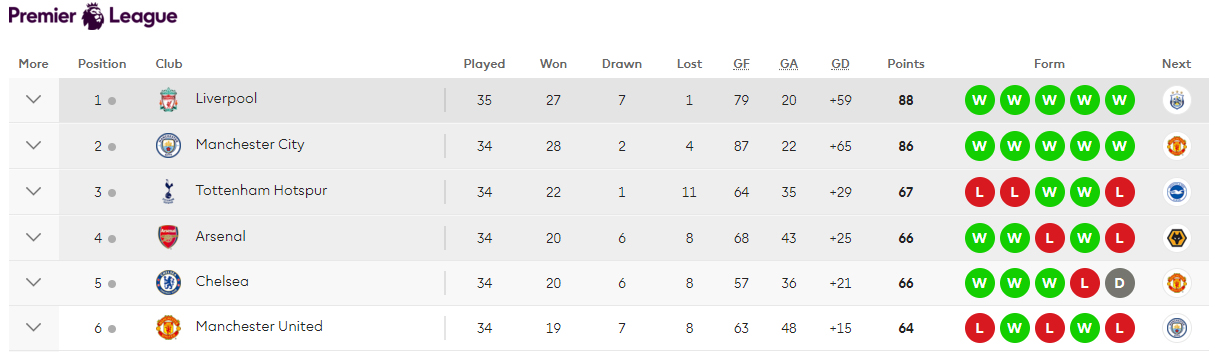
Spurs have lost seven of their past 11 Premier League matches, and had this been any other season, with any other challengers, surely this recent run of results would have knocked Tottenham out of European football for next season. Yet, while Spurs have struggled and have gained only three of a possible 12 points since 20 April (thanks to Michael Caley for the stat!), Chelsea have claimed only five, Manchester United only two and Arsenal (appallingly) only one.

Premier League table, following matches on 6 May (source: http://www.premierleague.com)

Although Spurs, who played with nine men for 43 minutes, were defeated by a beach bound Bournemouth side with nothing on the line this past Saturday, it was Arsenal’s 1-1 tie with Brighton and United’s 1-1 draw with Huddersfield the following day, that nearly assured Spurs’ fourth consecutive Champions League qualification. Arsenal will need a Spurs defeat to Everton, and will need to overturn an eight-goal difference in victory against Burnley on the final day. This seems highly improbable.

Spurs recent downturn in form can likely be explained by a few factors, which underlie why performances, other than a few moments of magic, have been largely staid and static over the last several weeks.

Injuries and lack of depth

Much has been made of Spurs’ lack of transfer activities this season, and they are the first and only side in Premier League history to not make a single transfer in the lead up or during the season. This was largely justified, as the club’s financial resources were tied up in expenses related to the new stadium, and the cost for the most marginal of players was deemed overly indulgent and not financially prudent (eg: Wilfried Zaha or Jack Grealish for £50 million). Likewise, the acquisition of Lucas Moura and Moussa Sissoko in recent windows proved that Mauricio Pochettino’s system takes some time for even the most cultured footballer to acclimate to, as neither player was successfully integrated into the squad immediately, despite the high price tags. Yet, as the season has worn on, Spurs have experienced an injury crisis that they have been unable to effectively cope with.

Eric Dier has played a handful of matches since Christmas, and has looked a shadow of his best self (including a 45 minute horror show this past weekend against Bournemouth, in which he surely should have been sent off).

Harry Kane first injured his left ankle in January, late in a 1-0 loss to Manchester United. He hurried back in time for the North London derby in early March, never looked fully fit, and then reinjured the same ankle on 9 April, in the first leg of the Champions League quarterfinal against Manchester City. Kane, not only poaches goals, but is crucial in the club’s efforts to press and harangue opposition defenders, provide holdup play for the Spurs’ other creative players, and can also provide tactical flexibility, as he has the ability to drop back and make critical, incisive passes. Spurs have survived in the Champions League without Kane, largely due to the explosive pace of Son Heung-min and his devastating counterattacks. However, when Son misses matches (as he did in the first leg of the Champions League semifinal, or in the second half of the match this past weekend against Bournemouth, as he was sent off), Spurs look slightly beyond their best in trying to cope with an energetic but inefficient Lucas Moura, a lumbering Fernando Llorente and even the much maligned, long forgotten, Vincent Janssen (who has made two recent, late substitute appearances in recent weeks).

Harry Winks has proven to be an indispensable and more important link in Spurs’ buildup play over the last two seasons, and has notched a few memorable moments namely his performance at the Bernabeu in the Champions League group stage in 2017, and his late second match winner this past January at Fulham. However, Winks suffered a groin injury in early March, and other than featuring for 21 minutes against Crystal Palace in the first match at the new stadium, he has been out of the lineup. Winks underwent surgery on his groin late last month, and has been unable to contribute to this deep European run. Without Mousa Dembele, who was sold to the Chinese League in the January window, and without a healthy Eric Dier, Spurs have had to use Moussa Sissoko relentlessly in the second half of this season. Sissoko himself was hurt in the Champions League quarterfinal, second leg, and the much less mobile Victor Wanyama was forced to cover. Winks’ vital role in the squad was exposed during this period.

Erik Lamela (who has not played since the North London derby in March) and Serge Aurier (who has missed ten matches in a row) have been also injured with groin and hamstring injuries. Although neither player have been starting many matches this season, they have proven to be reliable covers at their respective positions, their absences further compounding Pochettino’s issues with squad depth.

Diminished performances from Dele Alli, Christian Eriksen and Kieran Trippier

Much of Spurs’ success over the last four seasons has been due to the quality of performances delivered by Dele Alli and Christian Eriksen. Because of the issues related to injury and the lack of depth, Pochettino has had to rely moreso on Christian Eriksen to provide the club with some quality and creativity, particular when Kane, Son and Dele have been out. Eriksen is second on the club in minutes played this season at 3,859 in all competitions (only Toby Alderweireld has played more at 4,093) and has been the leader in minutes played over the last four seasons. Surely coming off a long summer, in which he captained Denmark to an appearance in the round of 16 at the World Cup, there must be an element of fatigue. Eriksen’s performances have been largely inconsistent and he has shown a lack of quality at times, hitting errant passes or misfiring shots over the target. Though he has notched nine goals this year, including big goals in the Champions League to help the club qualify for the knockout stage, he is behind last season’s 14 and the 12 he scored in 2016-17.

Dele Alli has also been wildly inconsistent this season, missing time in January through March with a hamstring strain, and fracturing his hand against Manchester City in the Champions League quarterfinal. Dele has scored only seven goals this season, and only once since Christmas. This pales in comparison to the 22 goals he scored in 2016-17. Additionally, due to the injuries in midfield, Dele has had to play in various roles in the midfield, from the wing, and into more defensive roles (as he did against Manchester City, when Moussa Sissoko was injured in the second leg of the quarterfinal). He continues to generate chances, as evidenced this past weekend with multiple attempts on target. However, the cutting edge has been largely lacking.

Kieran Trippier, who was viewed as a golden boy and one of the best right backs in the Premier League after his impressive showing with England at last summer’s World Cup, has had a disastrous season. Trippier’s strengths include his crosses and set pieces, both of which have failed to live up to the same standard he provided last season and during the World Cup. Additionally, he has been a liability defensively, prone to taking an extra, careless touch. Stats provider, Squawka, noted Trippier gave away possession 28 times in the first leg of the Champions League semifinal against Ajax. Pochettino could have relied on Serge Aurier to fill in for Trippier, but again, Aurier has been injured for much of the second half of the season. Kyle Walker-Peters has also slotted into right back duties this season, but his inexperience and defensive frailty have also been part of the reason he has been held out in the more important matches. Pochettino has also been forced to play Juan Foyth out of position as a right back, most notably against Manchester City.

With all these issues affecting the club, it is a wonder how Pochettino has managed to guide the squad to such accomplishments this season. He has certainly received a bit of luck in the league with the collapses of his biggest rivals for top four position, and a bit of pixie dust in the Champions League quarterfinals (VAR anyone?), but based on the most recent results in the league, the worry is that the clock will strike midnight for Cinderella later this week.

Jaideep Kanungo

On Spurs: Running on Empty

Although the stage for the evening was grand and far beyond any realistic dreams for the club at the outset of the current season, the first leg of the Champions League semifinal at the Tottenham Hotspur Stadium was met with a slight sense of dread and foreboding amongst the club’s most ardent supporters.

For one, Spurs were up against an upstart, dynamic, giant-killing Ajax side, that stylishly disposed of European giants Real Madrid and Juventus, and crucially won away legs at two of the most revered and hallowed venues in all of sport.

Spurs meanwhile limped into the evening, having lost at home in the Premier League on the weekend against West Ham. It was a match that Spurs lost control of in the second half, and after Michail Antonio bullied past Davinson Sanchez and slotted a 67th minute winner past Hugo Lloris, Spurs were completely spent. They were out of gas, out of inspiration and out of options, as Mauricio Pochettino desperately put out an impotent duo of Vincent Janssen and Fernando Llorente to search for a late equalizer. Not surprisingly, it did not come.

(NOTE: Janssen came on as a late substitute in the previous match, a 1-0 win versus Brighton, and made his first appearance for the club since August 2017)

Devoid of energy, Spurs were also undermanned for the semifinal. An incandescent source of light and pace this season, Son Heung-min was ruled out, suspended after accumulating a second yellow card in the second leg of the quarterfinal. The club was also decimated with injury, with Harry Kane recovering from his ankle injury, Harry Winks having had surgery on his groin earlier in the week, and Serge Aurier and Eric Lamela still sidelined with groin and hamstring issues. There was also doubt as to whether the graft and power of Moussa Sissoko would feature, as he too was recovering from a groin strain, and missed the previous two Premier League matches against Brighton and West Ham.

Pochettino elected to start the semifinal with a lone defensive midfielder in Victor Wanyama, protecting a back three of Jan Vertonghen, Sanchez and Toby Alderweireld. Danny Rose and Kieran Trippier were deployed as wing backs, with Dele Alli and Christian Eriksen playing behind Llorente and Lucas Moura. This certainly did not feel like Spurs’ first team, and definitely did not feel like a team that was ready and confident to play on one of the sport’s grandest stages, a European Cup semifinal.

The stage fright absolutely froze Spurs in the first half hour, as Ajax played with a dizzying, free form bravado, redolent of the swashbuckling Ajax and Dutch sides of 1970s. Spurs were clearly stuck in a freeze frame, clearly second best in every aspect, and during this first half hour, held only 31% of the possession. Yet, remarkably, Spurs conceded only once, with Donny van de Beek finishing a glorious buildup featuring exquisite passing between David Neres to Lasse Schone to Hakim Ziyech to van de Beek, who caught Danny Rose woefully out of position. Van de Beek feigned once and then a second time, freezing Lloris, and cooly putting the ball into the net. Ajax were off.

Spurs’ bewilderment continued as the first half dragged on, and it was chiefly the medical staff that came under close scrutiny as play continued. In the 31st minute, former Ajax now Tottenham central defenders, Vertonghen and Alderweireld both leaped simultaneously to play a cross in the Ajax penalty area, and forcefully clashed heads. Vertonghen took the worst of the knocks, with his nose squarely hitting the back of Alderweireld’s head. What followed was akin to a scene out of an over the top war movie, as blood gushed out of Vertonghen’s nose, and the medical team frantically attempted to control the carnage. Following the repairs, Vertonghen was allowed back onto the pitch in the 37th minute, and within moments, proved that he indeed did have a concussion, appearing woozy and unsteady on his feet. As he walked off the pitch, he collapsed into the arms of Pochettino on the touchline, and clearly was not in any state to continue.

Spurs’ doctors will claim that all the proper concussion testing was done on Vertonghen in the six minutes that passed between initial contact and the time that he was allowed back onto the pitch, however, this of course is impossible. Given the impact of the collision, the symptoms he demonstrated in the immediate aftermath, an independent physician or medical team would have recommended that Pochettino make a substitution, that there be no way that Vertonghen would be in any state to continue. While that ultimately did happen, the optics of the initial missed diagnosis were made apparent to the millions of viewers watching from afar. Rightfully, questions will be asked about how concussions are diagnosed, whether football has a problem in spotting, diagnosing and managing them, and whether club medical staff are inherently too invested in the results on the football pitch to properly care about the players and their health off of it.

Much like Vertonghen, Spurs left the pitch at the end of the first half dazed, bloodied and confused. They clearly lacked the pace of Son Heung-min to lead explosive counterattacks, an x-factor that helped the club earn results against Dortmund in the round of 16 and Manchester City in the quarterfinal. They also continued to lack the incisiveness of Kane to rip open the Ajax defense, and keep them on their toes. Fernando Llorente’s lack of pressing game also enabled Ajax to efficiently build attacks from the back.

Yet, despite many of these inadequacies, it was the man who replaced Vertonghen, Moussa Sissoko, who helped provide some stability and balance to the Spurs’ side. Sissoko provided excellent transition up the pitch, and helped provide attacking players with more opportunities to create chances. As the second half wore on, Ajax seemed content to sit further back, and Spurs launched more crosses into the penalty area. Spurs improved their final possession numbers to 52-48 for Ajax, and finished the night with seven shots versus Ajax’s four. Unfortunately, none of those chances amounted to anything of true substance.

A possible moment of importance that we may reflect on in a week’s time as a turning point, took place in the 78th minute, as Ajax continued to show occasional flickers of their first half-hour brilliance. With Spurs launched forward to look for an equalizer, Noussair Mazraoui led a dogged counter attack, laid off to Dusan Tadic in the box, who found David Neres uncovered in a dangerous area in front of goal. Neres’s left footed shot froze Hugo Lloris, and stopped the hearts of Spurs’ supporters, as it dribbled in slow motion, hit the goal post, and quickly popped out for Sissoko to clear from danger. If something had gone right for Spurs, it was that.

Two away goals for Ajax would have made a comeback in Amsterdam extremely difficult, but this glance off the post was a fortuitous gift that leaves next week’s return leg with everything still to play for.

There remains a glimmer of hope yet, and if this Spurs team has shown anything this season, it is that they perform best when there remains the faintest traces of hope.

Jaideep Kanungo

On Spurs: Looking back and ahead

It has certainly been a remarkable and historic past month for Spurs, one that will live long in the collective memory banks of its supporters.

This season was billed as a monumental one in Spurs’s history, as the club would return back to its home in North London, after its home matches last season were played at the relatively cavernous and soulless Wembley Stadium. After delay after delay, where more home fixtures were moved to Wembley, finally, the first match at the new Lane was played earlier this month.

The brilliant, and increasingly worthy of folk-hero status, Son Heung-min fired Spurs’s first goal in their new home on 3 April, and helped pace Tottenham to a 2-0 win over local rival, Crystal Palace. The stadium truly sparkled that evening, lest of which was the din generated by the impressive, rising Kop-like south stand. What also stood out to viewers from afar was how close to the action the stand was, and any anxiety that the team would need a transition period to discover the nooks and crannies of their new ground was quickly abated

Amidst the excitement of boasting the finest football stadium in Europe, and all its modern trappings, it was a relief to fans that it appears to have preserved the requisite atmosphere of a proper football ground. With this in hand, Spurs embarked on a trilogy of matches against England’s finest club and manager. Two Champions League quarterfinal legs, and a crucial Premier League clash would define the club’s season, and write a defining narrative in Mauricio Pochettino’s tenure with the club.

The first of the three matches was the first leg of the Champions League quarterfinal, played at the new Spurs stadium on 9 April. An immediate flash point took place early in the match, when a Raheem Sterling errant shot was blocked by Danny Rose. It all seemed quite innocuous, and there was no protestation from City, but through VAR, it was deemed that Rose had in fact blocked the shot with his hand, and City were awarded a penalty. That moment set the tone for the remainder of the tie, and Hugo Lloris’s massive penalty save on Sergio Aguero gave Spurs a tremendous jolt of belief. They fired eight shots on target in the first half, compared to City’s four, and the increasing confidence manifested in another Son goal in the 79th minute to give Spurs a 1-0 victory.

Crucially, Spurs would not concede at home, and the club left the match hoping that a semifinal berth would be possible. However, much of this enthusiasm may have been tempered as Spurs’s talisman Harry Kane lunged into a challenge with Fabian Delph, and injured his left ankle for the second time in 2019. It has become an all too familiar sight of seeing a disconsolate Kane hobble off the pitch, perched atop the shoulders of the club’s physios. Considering that Kane had just returned after a six week recovery period from his last injury in January, it was likely that he would be missed for the remainder of the season. The walking wounded tally would mount as well, as Dele Alli broke a bone in his left wrist in the final moments of the match, and the vitally important, Harry Winks, hurt his groin in training later in the week.

Spurs would be forced to rely on many of their reserves in the 13 April Premier League match at home against Huddersfield Town. With the race for the top four spots in the Premier League being separated by a handful of points, every match has proved to be a must win scenario.

Pochettino fielded only Christian Eriksen, Moussa Sissoko and Jan Vertonghen among outfield starters who played against City midweek, and the already relegated Huddersfield proved helpless in trying to cope with Victor Wanyama and the tricky Brazilian forward, Lucas Moura. Wanyama elegantly glided towards the Huddersfield goal and slotted in Spurs’s first goal of the afternoon. Moura proved to be a dizzying force for the increasingly bamboozled Huddersfield defense, and notched a hat-trick, his first in European football. The victory kept Spurs in third position, on 67 points, with Arsenal, Manchester United and Chelsea all within striking distance to pass.

The second leg of the Champions League quarter final took place on 17 April at the Etihad Stadium, and after 96 minutes of pure exhilarating, pendulum-swinging, heart stopping football, Spurs came out on top, and incredibly have a Champions League semi-final match against Ajax to look forward to. Without Kane or Winks, the prematch expectation was that Pochettino would bunker down, play with defensive graft and set up to spring Son Heung-min on leggy counter attacks. An away goal would force City to score three, and many prognosticators felt that even with City at their devastating best, that would be a difficult task.

Within the first 21 minutes, that purview of expectations for the match went out the window. Sterling put City up within four minutes, and Son then replied in the seventh minute, and put Spurs into a dream like state when he scored his second in the tenth. Bernardo Silva would score a minute later, and then Sterling scored his second on a brilliant cross from the genius, who hardly featured in the first leg, Kevin De Bruyne, in minute 21. It was 3-2 City, and suddenly the pendulum had swung back in their corner. The goals came at such a frenetic pace that it was difficult to process who truly had the upper hand, and who was leading the tie through aggregate.

Moussa Sissoko, who has proven to be one of Spurs most vital players this season, was turned inside out by De Bruyne, and seen clutching his groin as the Belgian wizard waltzed by him. It was only the 40th minute, and Sissoko could no longer continue. As the Spurs’s bench became increasingly thin, Pochettino curiously put out Fernando Llorente to replace him, and dropped Dele Alli (who himself was recovering from his hand injury) to play deeper in Sissoko’s role. This switch further deepened Spurs’s supporters sense of angst. Lloris was forced to make a series of impressive stops early in the second half, including a ten-bell left handed punch out of a De Bruyne missile. De Bruyne, ever so dangerous (which raised the obvious question of why Pep Guardiola was reluctant to use him in the first leg), sashayed through the Spurs defense, and found Aguero who scored a trademark, near goal, tight angle finish to put City 4-2 up with a half hour to play.

If this result held, City would have gone through, but in the 73rd minute, it was Fernando Llorente who put his hip (or hand?) on a corner, which found itself in the back of the City goal. Even with VAR, it was difficult to determine whether Llorente got his hand on it, and the goal was given. The gap was closed to 4-3.

Not surprisingly, as the match neared its end, the drama ratcheted up. The climax took place in the 93rd minute. The normally calm Eriksen, was harried and pressed by three City attackers, and made an ill-advised back pass, which caught Ben Davies out of position. The ball was flicked by Bernardo Silva, onto the foot of Aguero, over to Sterling, and behind Lloris. Guardiola, Sterling, and the entirety of the Etihad crowd broke out into sheer pandemonium, as the Spurs players crumpled to the ground. It was 5-3 City. However, technology once again turned the tide of a tie, and deemed that Aguero had been offside upon Silva’s slight flick. The goal was overruled, Spurs had a reprieve and another chance at life, and the full time whistle eventually blew without further incident. Spurs’s dreams of a semifinal, the first for the club since the 1962 European Cup, became a reality.

Given the theatre and drama of the midweek match, it would have been unfair to expect that the Premier League match back at the Etihad, three days later, on 20 April, could live up in terms of drama and memorable moments. Like in the quarterfinal, City took the attack immediately to Spurs, and like they did midweek, scored in the first five minutes. Once again, it was the brilliance of Bernardo Silva and Sergio Aguero, who found the head of City youngster, Phil Foden, who put Guardiola’s boys up 1-0. Despite the obvious importance of the match, for City’s title challenge with Liverpool, and in Spurs’s need to remain in the top four, the match really did feel like an anticlimax.

After generating a couple of terrific counterattack opportunities through Son and Eriksen early in the match, Spurs were quite listless, drained of its energy and emotion, attacking impetus, and creativity in the second half. City would claim the three points, and left Spurs with another loss (their fifth in eighth matches, since the first leg of their Champions League round of 16 match against Dortmund).

As we approach the final month of the season, Spurs are in a dog fight on two fronts. Thankfully, the results at other grounds appeared to have helped their cause after this past weekend.

Battle for top 4 (www.premierleague.com)

In the Premier League, while Spurs dropped three points, this past weekend saw Arsenal lose 3-2 to Crystal Palace, and Manchester United lose to Everton 4-0. Additionally, Chelsea drew Burnley 2-2 on Monday, 22 April.

Four matches remain for Spurs, and three of those matches are at home (Brighton tomorrow, West Ham on the weekend, and Everton in the final matchday of the season). They will also travel to the Vitality Stadium to face Bournemouth. This is in contrast to Arsenal, who has only one remaining fixture at the Emirates (v Brighton, with away matches to Wolves, Leicester and Burnley). Chelsea, after their draw to Burnley, travels to Manchester to face Manchester United, and will host Watford and travel to Leicester. Manchester United has the toughest schedule, set to face City in the Manchester Derby, Chelsea and then relegation bound Huddersfield and battlers Cardiff.

An unexpected Champions League run to the semifinals against giant killers, Ajax, will also preoccupy Pochettino’s list of concerns in the final weeks.

What may prove to be Spurs’s undoing is the mounting injury list, which now features not only stalwarts in Kane and Winks, but also the versatile Sissoko, who Pochettino has concerns for after his groin injury in the quarterfinal. Hugo Lloris, also missed the most recent City match after a mild injury, and his status remains uncertain. Pochettino also will miss the service of star man, Son Heung-min in the first leg of the Ajax semifinal, as he is suspended (for innocuously tugging on De Bruyne’s shirt half way through the second leg of the quarterfinal).

The last month has provided supporters of Spurs with many incredible indelible moments that we will surely not forget any time soon. As with football and sport at large however, memories only remain forever lasting if the season ends on a positive note.

Much remains to be written, but given what is at stake for a Spurs club that has been playing an increasing number of important games in recent years, surely an exciting denouement is expected.

Jaideep Kanungo