
On Spurs: In awe of the sublime wizardry of Tanguy Ndombele

As an adult, being a sports fan can be an exercise in tedium and dross. Most of the time we devote to watching sports can seem mundane and rather unordinary. Yet, the reason we tune in regularly is that every so often, we are reminded of why we fell in love with sports in the first place. It can come through a fleeting moment that makes us feel something bigger than ourselves, or can arise through an action of incomprehensible genius.

For Tottenham Hotspur, recent matches have largely been tedious affairs, as manager Jose Mourinho has siphoned off the free flowing football that has long been the trademark of the club, and has replaced it with a more conservative and tepid version. Too often, Spurs look unimaginative, as they concede possession and rely on their brilliant duo of Harry Kane and Son Heung-min to exploit their opponents on the counterattack.

This stark conversion would be altogether tolerable if Spurs were consistently achieving positive results, yet that remains a contentious claim of late. While Spurs now sit fifth in the Premier League table after 18 matches, and only four points behind leaders Manchester United (who Spurs smashed 6-1 at Old Trafford mere months ago), Mourinho’s side that is now purportedly embedded with his “winning mentality” has bled away leads against inferior opposition five times this season after 70 minutes (most recently, last week at home to bottom feeders Fulham) and have lost 10 points from winning positions.

And yet, in the midst of this negative football, there remains many flickers of inspiration that make the entire watching experience somehow worth it. The brilliance of both Kane and Son individually, and as a combination, have been espoused on these pages before. But week in, week out, the other player that grabs your attention and replenishes your joy for sport is the dazzling French midfielder, Tanguy Ndombele.

Ndombele arrived at Spurs in the summer of 2019 as the club’s most expensive transfer (£55 million from Lyon), and spent much of last season trying to acclimate to the physicality and pace of the Premier League, amidst the tumult of a significant managerial shift and a three month lockdown due to the coronavirus pandemic.

After a positive start in which Ndombele scored in the opening match against Aston Villa, the season progressively turned into a nightmare. Dealing with a string of hamstring and groin injuries, Ndombele completed 90 minutes for Mauricio Pochettino only four times before he was sacked in November.

Under Mourinho, Ndombele could never fully settle last season. After playing 90 minutes against Norwich at the end of December, he became an increasingly peripheral figure at the club. In the brief appearances he did make, he appeared portly and woefully out of shape (by Premier League standards of course), huffing and puffing after a few sprints, and unable to provide the defensive contributions that Mourinho seeks from his midfield players. Ignominiously, Ndombele was subbed off at half time against Norwich, in Spurs’ final domestic match before the coronavirus lockdown. He appeared lost and his transfer was widely panned as being a flop.

After football returned in June, there were rumours of a training ground dust up between manager and player, and genuine questions were raised in regards to whether Spurs were ready to move on from their record signing. Paris St. Germain and even Barcelona were reported to be interested in taking him on.

Fast forward to 2021, and here we are, the entire situation has turned. Ndombele has become an indispensable figure in Spurs’ attack, has taken on the mantle as the creative engine, and has left fans agog over the array of skills he has to offer.

The Frenchmen has an almost childlike bliss to his game, as he confidently flits around with the ball. It appears almost tied to his feet as he bamboozles opposition defenders, and launches his teammates into attacks with cheeky flicks with the outside of his boot. His complete control of the ball, his ability to juke and turn with it, gives me the picture of a young Tanguy, with the ball at his feet as he emerges from his bed, eats breakfast, walks to school, sits at his desk and goes about his day. Plain and simple, he is a wizard with the ball, and watching him provides us with moments every match that we simply thought were not possible.

One such moment came in yesterday’s Premier League match at Bramall Lane against Sheffield United.

Video should start with the Bergwijn/Ndombele interchange. If it does not, skip to 2:29.

Along with Pierre-Emile Højbjerg, Ndombele helped Spurs control the midfield battle for the first hour. At the 62 minute mark, he played a quick 1-2 with Stephen Bergwijn, and launched into the Sheffield United box. Taking the pass, slightly behind him, and with two defenders marking him out, Ndombele adjusted his body, fell back and hit an audacious chip with the outside of his right foot. The ball sailed over a helpless Aaron Ramsdale, and helped seal Spurs’ 3-1 victory.

The goal was quite simply, stunning. It was the best goal of Spurs’ season, and one of the best goals of the Premier League season. It was also wholly exemplar of the skill, panache and boldness that Ndombele demonstrates on a weekly basis.

Ndombele has rededicated himself at Spurs this season. He appears much leaner, more spritely and committed to the work that Mourinho demands, even contributing in the defensive phase, late in matches. His dedication has been rewarded as he has started 14 of Spurs’ 18 Premier League matches this season. Against Sheffield United, he completed the full match for the first time since that match against Norwich in December 2019.

Watching football every week can remain tiresome and feel perfunctory, and on many such occasions, you truly wish you did just about anything else to fill those two hours. Yet, the true artists like Tanguy Ndombele ensure that you tune in every week, because he is able to share some of that joy that he plays with and reminds you that football can indeed be fun and worthwhile.

Jaideep Kanungo

On Spurs: Oh Gareth, where art thou?

It all seems a like a hazy, distant dream now.

It was only three months ago, where he stood, triumphant, refreshed and relieved to come back to the club where he first made his name. He returned as a conquering hero, with all his fans reliving all the glorious pictures of the past, attempting to recapture even a sliver of the warm feelings he made them feel in those days of yore.

Gareth Bale had returned to Spurs a four time European Cup champion, owner of some of the most spectacular goals in European Cup history, and a bonafide global superstar of first order. With his return, immediately, Spurs’ attack became the envy of world football. Surely, adding Bale to a lineup featuring Harry Kane, Son Heung-min, Lucas Moura, Steven Bergwijn, Dele Alli, Eric Lamela, Giovani Lo Celso and Tanguy Ndombele, gave manager Jose Mourinho a wealth of options that his predecessor, Mauricio Pochettino, never had the luxury of even dreaming of.

Yet, nearly three months since Bale returned to Spurs, the Welshman has failed to make any tangible impact on the club, and his merely average performances during this span are starting to create some anxiety over what Spurs actually have underneath the hood.

The mounting stress results from a dreadful week for Spurs, in which they won only one point in three Premier League matches; drawing Crystal Palace 1-1, losing at Liverpool and falling at home to Leicester (2-0). The sequence of bad results saw Spurs plummet from first in the table, to sixth, underlining just how competitive and tight the margins in the Premier League are this season.

Much of Spurs’ early success came from the otherworldly, sheer brilliance of Kane and Son, who combined exceptionally well to take Spurs to the top.

However, over the past week, although the two have scored (Kane against Palace and Son against Liverpool), there has been a slight lack of synchronization and sharpness from the pair. Part of that can be explained by opponents recognizing the dependence of Mourinho on his counter-attack, prompting them to neutralize the transition from the back to the midfield, nullifying opportunities for Kane to drop deep, and distribute for Son. This was evidenced in all three of the matches this past week, most recently with the dodged and determined efforts of Wilfred Ndidi and Youri Tielemans to conquer the midfield battle for Leicester.

Yet, in the few goal scoring opportunities that Spurs have managed over the past week, both Kane and Son have more often than not flubbed their chances, and with it, altering the narrative that follows. Against Liverpool, Kane mishit a header from a perfectly placed corner, straight into the ground, rather than at goal. Similarly, against Leicester, moments prior to Serge Aurier’s foul on Wesley Fofana which resulted in a Leicester penalty (and a 1-0 lead), Kane hit a pitch perfect Son corner with his head once again, but this time, well over the Leicester goal. Kane is credited for being one of the most clinical finishers in Europe, but his finishing was left wanting this past week.

Similarly, against Leicester in the first half, Son had a series of opportunities, where he chose to play a cross or head for an opponent, rather than take the prime opportunity for himself, squandering some of the rare dangerous opportunities that Spurs were able create.

Had any of these chances been taken (as they were in earlier matches this season), the story would be different. Yet, when Kane and Son are slightly off, based on Mourinho’s wealth of attacking options, it would be reasonable for others to occasionally take the burden off the sensational duo.

Much of that expectation should fall on Gareth Bale, who even with Spurs covering approximately 40% of his salary, is still the Premier League’s highest weekly earner. Sadly, Bale’s time at Spurs thus far has been unremarkable. He missed the first month of his return, recovering from a slight knee injury, and it feels like he has never fully settled since.

Since coming into the team against West Ham in mid October as a substitute (and watching the Hammers storm back from a 3-0 deficit, to equalize 3-3, in his 18 minutes on the pitch), Bale has only appeared in three Premier League matches (against Brighton, West Brom and Leicester). Although he did score a sitter against Brighton, his impact has been nominal. Bale has done most of his work in the Europa League group stages, where he featured in all six group matches, scoring once (against LASK in Linz), but never playing more than 82 minutes in a match.

Bale’s playing time at Real Madrid was cut short last season, as he gradually fell out of favour with manager Zinedine Zidane. As the club chased down another La Liga title, Bale featured in the team only twice since the return to play following the coronavirus lockdown, with his last action coming on 24 June. Given the long absence from playing top flight football, it was reasonable to expect that Bale would take some time to regain his fitness, especially with trying to acclimatize to a league that plays at a break neck pace like the Premier League.

Though harsh, it is completely fair to say that thus far, Gareth Bale looks merely a shell of the player that absolutely electrified the crowds at White Hart Lane many years ago. With the Wales national team, Bale often appeared like an all conquering, all action hero, involved in all phases of the game. His performance at Euro 2016 was scintillating, out of this world, as he guided his small country to the semi-finals of the competition.

Increasingly, in his return, Bale looks isolated on the right wing, seemingly out of sync with the rest of the midfield. In general, he looks far too languid, and bereft of the explosive thrust that marked his game during his first spell at Spurs. Perhaps at age 31, our expectations of him rampaging down the right flank were miscalculated. Perhaps, his history of muscle injuries have created a sense of hesitation and tentativeness, which has robbed him of his attacking flair.

Indeed, Mourinho has preferred Steven Bergwijn and occasionally Lucas Moura, to play in Premier League matches since Bale’s arrival. This season has brought a greater buy in of Mourinho’s tactics by the team. Over this time, it has become clear that much of his defensive philosophies require attacking players to track back and contribute to the defensive phase. This has been of paramount importance as Spurs now have attacking fullbacks on both flanks.

Over recent weeks, it has been Bergwijn who has demonstrated the requisite work rate and commitment to defensive duties, providing reinforcement for Serge Aurier at right back, while still having the pace to burst out on attack during the counter-attacking phase. Son Heung-min has also provided a similar service to help support Sergio Reguilon on the opposite side. Until now, Bale has yet to show Mourinho the level of fitness, pace and defensive acumen that he expects of his wingers, to earn a spot in his starting XI, week in and week out.

Against Leicester, after trailing 1-0 at the half, Mourinho brought on Bale to change the complexion of the game, substituting him on for Spurs’ creative spark, Tanguy Ndombele. It was quite unfortunate that mere minutes after that switch, the other creative spark, Giovani Lo Celso was injured with a muscle strain, and also had to be substituted (for Lucas Moura). Within such a short period of time, Spurs were without two of their most creative players, who could unlock a defense, and find space in contexts devoid of it.

The once feared trio of Son, Kane and Bale failed to make an impression, their play so disjointed, so static, so listless, and Leicester gradually took over the match. It truly was no contest at the end.

Given the wealth of attacking options that Mourinho has at his disposal, it is unfair to expect Kane and Son to provide all the offensive impulses for Spurs going forward. Yet as this season has progressed, it appears that without their contributions, the rest of the team has been unable to provide a similar lift.

Counting out Gareth Bale and Spurs now seems somewhat rash, and it does not appear that anybody is keen to partake in that, considering how tight the Premier League is at the moment. But for Bale to maintain the sheen of genius and upkeep the striking legacy that he left in his first spell, it would serve him well to find, if only a mere glimpse, of what made him special all those years ago.

If Bale can find that quality, and ultimately contribute towards a veritable title challenge for Spurs, perhaps that dream can last just a little bit longer.

Jaideep Kanungo

On Spurs: Disappointment and 0 points after a top of the table clash

Moments after the final whistle of Tottenham’s 2-1 heartbreaking defeat to Liverpool at Anfield tonight, the cameras panned to the ritualistic handshakes between Jose Mourinho and Liverpool manager, Jürgen Klopp. It initially appeared to be a civil exchange, but clearly Mourinho had said something inciteful, which caused Klopp to look at him with a toothy grin of disbelief.

After the match, it was revealed that Mourinho had told Klopp that “the better team had lost.”

Although the run of play, the possession dominance (76% v 24%) and shots on target count (11 v 2) all favoured Liverpool in the end, from a Spurs perspective, it felt hard-done by not coming out of that match with at least a draw, if not with complete victory.

It was clear to anyone that had watched Tottenham this season, that Mourinho would set Spurs up in this defensive, low-block posture, trying to wait for Liverpool to lose possession, and then marching up the pitch with explosive and clinical counterattacks. It was entirely expected that Liverpool would win the bulk of possession, take the majority of shots (most of which being low percentage in nature), and the match played out almost exactly to Mourinho’s best laid plans.

For much of the first half, Liverpool comfortably hemmed Spurs in their own end. Spurs’ back line was under significant pressure, and failed to provide any service to either Son Heung-min or Harry Kane in the few flits of possession. After a series of grazing Liverpool shots which were comfortably stopped by Hugo Lloris, in the 26th minute, it was Liverpool’s Mohamed Salah, who pounced on an errant clearance at the edge of the box, and took a dangerous shot which took a slight deflection off Toby Alderweireld, and floated over a frozen Lloris. The Kop celebrated in delight. Advantage Liverpool.

In the brief moments Spurs did win the ball after the Salah goal, Liverpool harangued Spurs’ backline with its usual ferocity. On one occasion, Serge Aurier was guilty of giving the ball straight back to Mané, to recycle a sequence of possession for the Reds, and Trent Alexander-Arnold had his way, with an audacious nutmeg of Son. Everything seemed to be going well for the defending champions, and the Anfield crowd, all kept in the Kop end, were in their usual rapturous delight.

Spurs were able to release some of the fizz from the can in the 33rd minute. The equalizer came from a goal kick, that was quickly taken, and retrieved by Giovani Lo Celso in midfield. Lo Celso played an excellent through ball to Son on the left flank, and he exploded past Liverpool’s back line and hit a tidy right foot past the on-rushing Liverpool keeper, Alisson Becker. It was a textbook example of ” route one football,” and in a match where Spurs simply could not hold onto the ball, it was a brilliant goal that brought them back into the game.

While the first half was decidedly one sided, and Spurs managed only two counter attacking opportunities, where Spurs feel hard done by the end result, is that in the second half, they missed a series of high quality scoring opportunities. Of note, straight after the restart, Alderweireld launched Bergwijn on an attack down the left flank. On another day, Bergwijn would have finished, but sadly today, he fired well wide of goal. The look of regret was painted on his face, as if he sensed that such a glorious opportunity would not come again against such a high quality opponent.

As Spurs continued to valiantly defend, Bergwijn did indeed get another opportunity to score. This time, in the 63rd minute, Kane headed a goal kick onto Son, who flicked onto Bergwijn. With time, space, and his head up, Bergwijn hit a shot which incredibly went off the far post. That should have put Spurs up. While that was easily the best chance to go ahead, the next best chance came seconds later, when a Spurs’ corner found its way onto the head of an unmarked Harry Kane. Rather than hit it convincingly, it glanced off Kane’s head, took a heavy bounce on the grass, before being calmly collected by Alisson. Back to back chances, gone in an instant, nothing in hand.

Liverpool continued to turn the screw, ratcheting up the pressure, but Spurs generally coped with this tension well. The front three of Liverpool of Mané, Firmino and Salah were frenetic in their movement and danger. Most impressive of the three was the Senegalese Mané, who had a catalogue of turns, flicks and shots, but who was largely contained by his Ivorian rival, Serge Aurier.

Kane, who had missed his golden opportunity minutes earlier, like Bergwijn had a chance at redemption. He brought down an Alderweireld ball in the 79th minute, and even with seemingly endless time and space, he seemed to hesitate (possibly because he may have brought down the ball with his arm, or possibly because he could not believe the fortune that allowed him to be in such a wide open position, without being offside), and mishit the ball. Once again, for the fourth time in a half-hour, chance gone.

Spurs genuinely had a constellation of incredible opportunities, all flubbed, and so in the 90th minute when Firmino was first to the ball on an Andy Robertson corner, and placed a well timed and placed header past Lloris, it all felt slightly heartbreaking and unfair. They defended generally well, Aurier, Ben Davies, Dier and Alderweireld had been brave and overall, solid. Hojbjerg and Sissoko were exemplary in their reinforcement. All the attacking players made commendable defensive contributions. Yet, Liverpool took their chances, while Spurs misfired on theirs.

Mourinho’s quip to Klopp, that “the better team had lost” may seem petulant, and out of touch with reality to observers that looked at the box score, and saw the one sided possession and shot totals. Yet, for nearly the entire second half, Spurs had the growing belief that they could indeed eek this match out, and create a gap at the top of the table. The 90th minute winner popped that bubble.

To walk away from Anfield with a point would have been acceptable. For Spurs to leave with nothing from that brave match, to lose their place at the top of the Premier League table, it all feels slightly empty.

Jaideep Kanungo

On Spurs: Realism sets in as Spurs drop points

Truly for the past week, everyone at Tottenham had every reason to hold their heads up high. Spurs were top of the Premier League, powered by the league’s top goal scorer (Son), playmaker (Kane) and best defense, and had just come off resoundingly humiliating their North London neighbours.

Yet despite the positive feelings and overall good vibes, the week also brought along some genuine buzz kill moments, as manager Jose Mourinho attempts to guide Spurs to their first English top division title since 1961.

Firstly, The Athletic‘s doyen of tactics, Michael Cox, highlighted that Tottenham are currently outperforming their expected xG numbers and that a regression is to be expected. He writes (prior to this past weekend’s match at Palace) that Spurs had scored 23 goals, although their xG would expect 17 goals. Defensively, Spurs would have been expected to concede 12 goals, compared to the 9 goals that they actually conceded. Their defense would be 5th in the league in the xG table, rather than the best in the league as it stood. Most astonishingly, Son Heung-min was highlighted as significantly overperforming his xG. The South Korean has scored 10 in real life, when his expected goals was only 3.5. Surely, Cox and other football data-heads insist that Spurs simply cannot maintain this “mirage.”

Additionally, some football pundits such as the eminently forgettable ex Spurs’ midfielder Jamie Redknapp, and the classic “good football man”-cum-curmudgeon, Graeme Souness, commented that many of Spurs’ attacking players must be down on playing such a negative style of football. Interestingly, Spurs teams of the past had been criticized for playing an attractive attacking football, as compared to their rivals, but they lacked a general defensive solidity and winning nous that would make them legitimate title threats (is this not what critics panned Mauricio Pochettino for?). This manifested in a series of soul-crushing losses on some of biggest stages. Finally, enter a manager that has tightened up those areas of weakness, with a group of committed players, and witness the wrath of the “protectors of the proper way” to play football.

Yesterday’s 1-1 draw to Crystal Palace at Selhurst Park may have served as vindication for those skeptics. Spurs’ run of good form against good teams, and clean sheets (they had not conceded a goal in their previous four Premier League matches) took a sizeable hit, as it occurred against an opponent that sat 14th in the league table prior to the match.

The match was poised to be an interesting tactical battle for Jose Mourinho, who had set his team up in his classic low-block shape in the preceding three matches, against Manchester City, Chelsea and Arsenal. It was reasonable to assume that all three of those rivals felt comfortable playing with the ball, and that Mourinho could set up his team to play on the counter. However, Roy Hodgson’s Crystal Palace offered a much different proposition, themselves preferring to play Mourinho’s favoured style. Palace boasts a trio of tricky attacking players in Wilfried Zaha, Eberechi Eze and Christian Benteke, that could also be devastating on the counter, as demonstrated by their five goal explosion against West Brom in the prior week.

The match was played in a seemingly uncomfortable setting (judged as such, from the comforts of our warm, cozy home), with the rain pouring down for the entire 90 minutes. Palace also had the benefit of 2000 boisterous fans in their bandbox stadium, for the first time since the coronavirus lockdown. (Admittedly, I have always admired Selhurst Park. It has always seemed from afar as the stadium with the tightest confines, with one of the best atmospheres in the Premier League).

Spurs got the better of Palace for much of the first half, including a couple of breaks for Son (on a tidy direct ball from Alderweireld) and Steven Bergwijn (who was the beneficiary from an incisive Kane ball), which failed to result in a goal. The half was punctuated by yet another terrific goal from Harry Kane. Kane took a feed from Son in close space, just outside the Palace box, and hit a swerving right footed strike that proved tricky for Palace keeper, Vincente Guaita.

At that point, it seemed a game that Spurs would comfortably win, but as the second half wore on, they seemed sapped of their energy and any inventive attacking ideas. It would be easy to suggest that Spurs should have attacked more, and played more on the front foot in the second half. In his post match comments, Mourinho admitted that these were his exact instructions to the team.

Yet, to be fair, it was Palace that made it difficult for Spurs to play from the back, harrying Spurs backline, forcing many bad decisions and turnovers. Midfielders Hojbjerg and Sissoko were forced to defend more, and were unable to link with the attacking players. Distribution to Kane and Son was completely nullified. Crystal Palace were allowed to dictate the tempo and they continued to mount a series of chances.

The most eye catching Palace player was the electric Eze. A complete revelation, Eze was lean, elegant, with an almost balletic quality, and left Spurs’ midfield for dead on several occasions. As the second half wore on, Spurs badly faded, and were forced to concede multiple set pieces. Luckily for them, Christian Benteke continued to lack finesse in completing pitch perfect delivery, otherwise, the equalizer would have come much sooner. Eventually, in the 81st minute, Eze floated in free kick which proved a difficult knuckleball for Hugo Lloris. Jeffrey Schlupp was in proper position, to pounce on the rebound and smash it into the back of the net. Palace had equalized, and it was the first league goal Spurs had conceded since 1 November.

It felt that the goal was inevitable, based on the run of play. Although Spurs have been resolute in defending in recent weeks, they did concede late goals to Newcastle and West Ham in the first month of the season in an eerily similar fashion. In both those previous occasions, they had conceded late free kicks, near the edge of the box that resulted in a penalty (Dier’s controversial handball while trying to defend Andy Carroll of Newcastle) and a wondergoal (Manuel Lanzini’s smash and grab thump for West Ham). For a manager that harps on set piece defending and prides himself on his defensive record, seeing this equalizer come after a sequence of cheaply conceded set-pieces must have made Jose Mourinho completely (and rightfully) apoplectic at full-time.

It should be mentioned that despite their largely tepid performance in the second half, Spurs had two occasions to win the game late. In the 86th minute, Serge Aurier whipped in a hard cross, which took a quick deflection off Kane’s head. Remarkably, Guaita’s razor sharp instincts and quick movement prevented an otherwise sure goal. Palace once again relied on Guaita’s quality, when in the 93rd minute, he made an astonishing leap to deny a dipping Eric Dier free-kick from the edge of the box. The Spanish goalkeeper, who was panned for his movement and read of Kane’s first half strike, had thoroughly redeemed himself and was likely the Man of the Match by the end.

Luckily for Spurs, the disappointment of the afternoon was mitigated by the fact that all of their “Big 6” rivals dropped points during the weekend as well. Chelsea fell to Everton, while the Manchester Derby ended in an uninspiring, insipid 0-0 draw. Liverpool was flat against Fulham, and Arsenal continued through their woes, losing humiliatingly at home to Burnley.

Admittedly, Spurs did not look like a league leading side against Palace in this match. The passage of time tends to burnish our collective memories of how outstanding some of the great teams of the past were, and fill us with an apocryphal illusion that they played some version of a champagne football every time they graced a pitch. The reality remains that many great teams find ways to snatch victory in ugly games like this Palace game proved to be. Spurs nearly did, had it not been for the sublime brilliance of a Spanish goalkeeper. Yet, perhaps the skeptics like Michael Cox do provide a timely warning, that Spurs need further tactical refinement before being a true title contender. They cannot expect to play the same way against a Manchester City or Chelsea as they do against Crystal Palace, where they are rightfully expected to do more.

Championship teams show a tactical variety and an ability to get results in different ways. Perhaps a simple tactical change of playing nimble, quick ball distributors that can cope with a press, like Giovani Lo Celso or Harry Winks (rather than a heavy footed Mousa Sissoko), in front of the back line, could help provide service to the attacking players? Given the depth and variety of Mourinho’s bench, surely there is a Plan B or Plan C in the squad to handle teams that pose a significant challenge to break down.

This draw may have felt like a loss, considering the form that Spurs were on leading into the match, and the heightened expectations for what this season may bring. Yet, the way their other rivals have sputtered and have looked fatigued as the fixtures mount, Spurs have been given a true reprieve. They remain top of the table for now, and have been provided a reminder that they should seek some different ways to win games in the coming weeks.

Jaideep Kanungo

In a strange year, Spurs are on top of the league

Much has changed since my last correspondence on this mostly deserted, infrequently visited, uninspiring looking website.

Most strikingly, our understanding of the planet has been challenged, as a ‘once in a century’ pandemic has wreaked havoc on the world’s health and economies, and has thrust a spotlight on the range of social inequalities that many have ignored for far too long. In football land, the once antiquated, much maligned Jose Mourinho is now manager of Tottenham Hotspur, and against a backdrop of trendy pressing and high-line rivals, Spurs find themselves tied atop the Premier League table after eleven matches played in this most unusual 2020-21 season.

Many other excellent writers (namely Charlie Eccleshare, Jack Pitt-Brooke and Michael Cox of The Athletic, David Hytner and Jonathan Liew of The Guardian) have contributed exhaustive pieces for the reasons for why Spurs are top of the Premier League table for the first time since August 2014. In an effort to get back into writing, I will provide a succinct explanation, with hopefully more regular pieces to follow in the coming weeks and months:

Trusting the Manager

Undoubtedly, the sacking of Mauricio Pochettino in November 2019, was a jolt to anyone associated with the club. In his five full seasons at Spurs, Pochettino became a legendary manager, imposing an attractive style of football, developing several youngsters into star-calibre players, and taking the club to four consecutive ‘top 4’ finishes in the Premier League. His crowning achievement was leading Spurs to an unlikely Champions League Final appearance in 2019.

Unfortunately, during the peak of Pochettino’s era, as the club made the move from White Hart Lane to the new Tottenham Hotspur stadium (with a prolonged, inconvenient sojourn at Wembley Stadium), for a two year period, Spurs failed to invest in new players for their manager. Even though the 2019 summer transfer window brought new midfielders Tanguy Ndombele and Giovani Lo Celso to the club, the rest of the squad had grown old together and had become stale. Pochettino’s high energy system placed extreme physical demands on his players, that by the end, many likely felt burned out after years and years of his training methods (it is somewhat surprising to see that in the 18 month period after the run to the Champions League Final, four significant players (Danny Rose, Dele Alli, Christian Eriksen (at Inter Milan) and Fernando Llorente (at Napoli) no longer play regular, first team football) Through the early fall of 2019, results petered out and Pochettino became increasingly irascible and without an answer for his team’s mounting woes.

His sacking was an emotional blow for Spurs’ supporters, who experienced such heights under the Argentine manager (rivals will gleefully point to an empty trophy case), and the feelings of ill-will were further compounded when chairman Daniel Levy appointed Jose Mourinho as manager. Mourinho was loathed by a large segment of Tottenham supporters, from his tenure managing rivals Chelsea and most recently Manchester United, where he spectacularly flamed out with the club’s supporters and some star players. It became a genuine talking point in online forums, about what was more dour, Mourinho’s tactics, or his mood on any given day.

Mourinho’s first several months at Spurs were a mixed bag, as his footballing philosophy could not be more different to that of his predecessor. His job was made more difficult with significant injuries to his stars, Harry Kane and Son Heung-Min. Before football shut down in mid March due to the coronavirus pandemic, Spurs had fizzled out of the FA Cup in penalties to Norwich, were rendered impotent in the Champions League last 16 to RB Leipzig and were likely going to plummet down the Premier League table as well.

However, the three month lockdown on football, allowed Mourinho learn the idiosyncrasies of his squad, provided him the opportunity to indoctrinate them on his tactics, and allowed his star players to regain their fitness. With both Son and Kane fully fit, Spurs managed to claim points in all but two of their final nine matches, and finish a respectable sixth in the Premier League (Spurs had been 14th when he took over). His players were starting to buy in to his message, and even a malcontent like Tanguy Ndombele (the club’s most expensive transfer acquisition), who once appeared to be a lost cause and in the transfer heap, has rediscovered his joy and purpose.

Learning the Tactics

Over time, Mourinho has come to learn all the gadgets on his dashboard, and has had the opportunity to impose his tactical vision onto Spurs.

Of note, Mourinho has found confidence in his back line, which has been bolstered by resurgent performances from Eric Dier and Toby Alderweireld. While both players lack the pace and nimble footwork of a modern centreback, they make up for it with their excellent football intelligence, and extremely well timed challenges. Spurs also now have three dynamic, roving full backs in Sergio Reguilon (left back), Matt Doherty (right back) and Serge Aurier (right back). Last season, following the transfer of Kieran Trippier to Atletico Madrid, full back was a position of weakness for Spurs, with Ben Davies and Serge Aurier being the only consistent first team regulars (Japhet Tanganga filled the role admirably in spot duty, and Ryan Sessegnon and Kyle Walker-Peters proved to be too raw for full time duties). Mourinho felt comfortable playing a lopsided fullback system, where Ben Davies (left back) would remain deep and static (forming a back 3 in attack), allowing Aurier to roam forward and play as a right wing back, providing overlaps and crosses. This required Mousa Sissoko to drop back from his central midfield duties and occupy the right back role when Aurier was caught high up the pitch.

This season, with two roaming full backs, Spurs have been able to drop Sissoko and the impressive Danish central midfielder, Pierre-Emile Højbjerg into the back line to provide further reinforcement (Michael Cox has pointed out that against Chelsea, this took on the shape of a back 6). Højbjerg has been a revelation for Spurs this season, playing as a classic ball-winning, box to box central midfielder, the type that Mourinho had in his disposal in his previous table topping clubs. After defeating Southampton (at St. Mary’s) 5-2 and Manchester United (at Old Trafford) 6-1, where Spurs exposed the opposition high-lines and erratic defending, they have felt more comfortable conceding possession and playing Mourinho’s classic low-block shape for the bulk of their matches.

This structure has proven to be extremely effective. Thus far, after 11 matches, Spurs have conceded just nine goals, representing, for the moment, the best defense in the league. Impressively, in Spurs’ last three matches in a difficult series of fixtures, at home to Manchester City, at home to Chelsea, and at home to Arsenal, they did not concede a goal. Impressive stuff for a team that was hemorrhaging goals against toward the end of the Pochettino era.

Of course, low-block defensive football alone cannot win football matches consistently. Spurs have benefitted from explosive counter attacking options, led by the intelligence, skill and graft of their leader, Harry Kane, and the blinding pace and sublime clinical finishing of Son Heung-Min.

Whereas in previous seasons, Kane spent much of his time in opposition boxes, terrorizing defenders, playing more as a classic number 9, over the last year under Mourinho, Kane has evolved into a more complete player, and plays more as a number 10, who is involved in all facets of the game. He is often the player that clears balls out of his own box on opposition corners and has shown an incredible work rate, building on Mourinho’s tenet of having his attacking players involved in the defensive phase.

Kane’s game appears more complete this year, as he is often found in midfield areas bringing down balls from Dier or Alderweireld, briefly holding up the play, allowing Son to overlap him, and sending him perfectly placed and weighted passes into space behind opposition defenders. This simple, yet effective tactic has yielded superlative results, and remains largely unplayable (Thomas Partey and Granit Xhaka were the most recent victims, in the North London derby). After 11 matches, Son is on 10 goals (second in the league to Dominic Calvert-Lewin) and 3 assists, while Kane is on 8 goals and an eye-popping 10 assists (first in the league).

Having Squad Depth

Unlike under the final month of the Pochettino era, Mourinho has already earned the trust of a fawning chairman Levy, and has received greater investment in the squad. In addition to Doherty, Reguilon and Højbjerg, Spurs reinforced at centre forward with Carlos Vinicius (from Benfica), who has shown a touch of skill and pace in his Europa League duties, and centre back Joe Rodon (from Swansea). All of these new faces have blended in well at Spurs, and provides Mourinho with a veritable list of options, as the fixtures pile up in the coming month. This is true, without having even mentioned the return of Spurs’ progigal son, Gareth Bale, who came to Spurs as a raw, string bean 18 year old in 2007 from Southampton, and left six years later to Real Madrid as a fully developed world beater. Four Champions League titles on, Bale is back at Spurs (on loan, as he had not been able to get into the Madrid side, and quarreled with his manager Zinedine Zidane) with his smile intact, and his mood apparently lifted.

Curiously, Bale has yet to settle fully on the pitch, missing the first month due to a muscle injury, and only really appearing in Europa League matches, and occasional Premier League substitute appearances. Although he has scored twice, he has looked devoid of the thrust that defined his game during the apotheosis of his Spurs career. Thus far, he also does not appear to have the fitness to perform the level of defensive commitment that Mourinho seeks in his wingers (and what he has unlocked in Steven Bergwijn and Lucas Moura, who appear to be getting more Premier League looks).

Spurs overall look to be on the up after eleven matches. Too much football remains to make definitive conclusions, but reassuringly for us famished supporters, Mourinho appears to have bought the trust of his players, instilled them with his philosophies, unlocked the world class potential of Kane and Son, and has a bench full of hungry and committed players who will likely push their rivals to the end.

It really has been a gruesome year, but football once again reminds us, that there may be light at the end of the tunnel after all.

Jaideep Kanungo

On Spurs: Limping to the finish

For a club that had a brief surge after opening arguably the finest football stadium in the world this past month, that is a victory away from reaching the final of the Champions League, and that has remained in a top four position in the Premier League for much of the season, Spurs’ recent form is quite shocking as it is disappointing.

  • 23 February: Burnley 2 Tottenham 1
  • 27 February: Chelsea 2 Tottenham 1
  • 2 March: Tottenham 1 Arsenal 1
  • 9 March: Southampton 2 Tottenham 1
  • 31 March: Liverpool 2 Tottenham 1
  • 3 April: Tottenham 2 Crystal Palace 0
  • 13 April: Tottenham 4 Huddersfield 0
  • 20 April: Manchester City 1 Tottenham 0
  • 23 April: Tottenham 1 Brighton 0
  • 27 April: Tottenham 0 West Ham 1
  • 4 May: Bournemouth 1 Tottenham 0

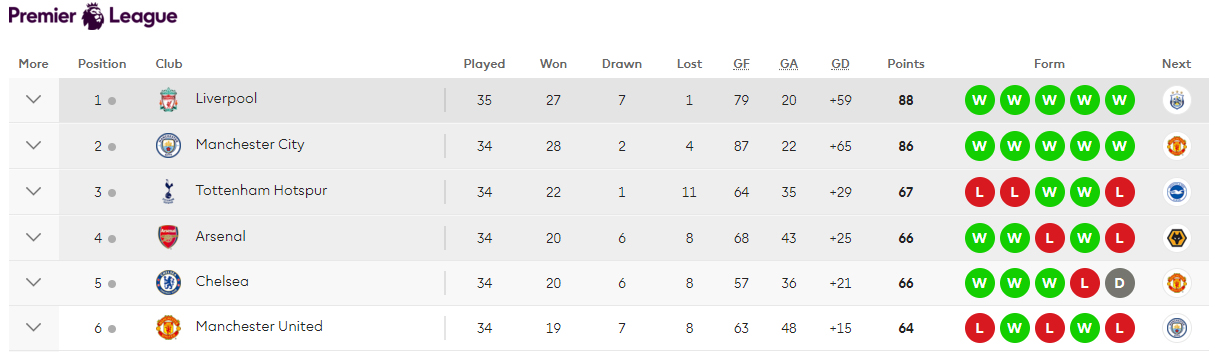
Spurs have lost seven of their past 11 Premier League matches, and had this been any other season, with any other challengers, surely this recent run of results would have knocked Tottenham out of European football for next season. Yet, while Spurs have struggled and have gained only three of a possible 12 points since 20 April (thanks to Michael Caley for the stat!), Chelsea have claimed only five, Manchester United only two and Arsenal (appallingly) only one.

Premier League table, following matches on 6 May (source: http://www.premierleague.com)

Although Spurs, who played with nine men for 43 minutes, were defeated by a beach bound Bournemouth side with nothing on the line this past Saturday, it was Arsenal’s 1-1 tie with Brighton and United’s 1-1 draw with Huddersfield the following day, that nearly assured Spurs’ fourth consecutive Champions League qualification. Arsenal will need a Spurs defeat to Everton, and will need to overturn an eight-goal difference in victory against Burnley on the final day. This seems highly improbable.

Spurs recent downturn in form can likely be explained by a few factors, which underlie why performances, other than a few moments of magic, have been largely staid and static over the last several weeks.

Injuries and lack of depth

Much has been made of Spurs’ lack of transfer activities this season, and they are the first and only side in Premier League history to not make a single transfer in the lead up or during the season. This was largely justified, as the club’s financial resources were tied up in expenses related to the new stadium, and the cost for the most marginal of players was deemed overly indulgent and not financially prudent (eg: Wilfried Zaha or Jack Grealish for £50 million). Likewise, the acquisition of Lucas Moura and Moussa Sissoko in recent windows proved that Mauricio Pochettino’s system takes some time for even the most cultured footballer to acclimate to, as neither player was successfully integrated into the squad immediately, despite the high price tags. Yet, as the season has worn on, Spurs have experienced an injury crisis that they have been unable to effectively cope with.

Eric Dier has played a handful of matches since Christmas, and has looked a shadow of his best self (including a 45 minute horror show this past weekend against Bournemouth, in which he surely should have been sent off).

Harry Kane first injured his left ankle in January, late in a 1-0 loss to Manchester United. He hurried back in time for the North London derby in early March, never looked fully fit, and then reinjured the same ankle on 9 April, in the first leg of the Champions League quarterfinal against Manchester City. Kane, not only poaches goals, but is crucial in the club’s efforts to press and harangue opposition defenders, provide holdup play for the Spurs’ other creative players, and can also provide tactical flexibility, as he has the ability to drop back and make critical, incisive passes. Spurs have survived in the Champions League without Kane, largely due to the explosive pace of Son Heung-min and his devastating counterattacks. However, when Son misses matches (as he did in the first leg of the Champions League semifinal, or in the second half of the match this past weekend against Bournemouth, as he was sent off), Spurs look slightly beyond their best in trying to cope with an energetic but inefficient Lucas Moura, a lumbering Fernando Llorente and even the much maligned, long forgotten, Vincent Janssen (who has made two recent, late substitute appearances in recent weeks).

Harry Winks has proven to be an indispensable and more important link in Spurs’ buildup play over the last two seasons, and has notched a few memorable moments namely his performance at the Bernabeu in the Champions League group stage in 2017, and his late second match winner this past January at Fulham. However, Winks suffered a groin injury in early March, and other than featuring for 21 minutes against Crystal Palace in the first match at the new stadium, he has been out of the lineup. Winks underwent surgery on his groin late last month, and has been unable to contribute to this deep European run. Without Mousa Dembele, who was sold to the Chinese League in the January window, and without a healthy Eric Dier, Spurs have had to use Moussa Sissoko relentlessly in the second half of this season. Sissoko himself was hurt in the Champions League quarterfinal, second leg, and the much less mobile Victor Wanyama was forced to cover. Winks’ vital role in the squad was exposed during this period.

Erik Lamela (who has not played since the North London derby in March) and Serge Aurier (who has missed ten matches in a row) have been also injured with groin and hamstring injuries. Although neither player have been starting many matches this season, they have proven to be reliable covers at their respective positions, their absences further compounding Pochettino’s issues with squad depth.

Diminished performances from Dele Alli, Christian Eriksen and Kieran Trippier

Much of Spurs’ success over the last four seasons has been due to the quality of performances delivered by Dele Alli and Christian Eriksen. Because of the issues related to injury and the lack of depth, Pochettino has had to rely moreso on Christian Eriksen to provide the club with some quality and creativity, particular when Kane, Son and Dele have been out. Eriksen is second on the club in minutes played this season at 3,859 in all competitions (only Toby Alderweireld has played more at 4,093) and has been the leader in minutes played over the last four seasons. Surely coming off a long summer, in which he captained Denmark to an appearance in the round of 16 at the World Cup, there must be an element of fatigue. Eriksen’s performances have been largely inconsistent and he has shown a lack of quality at times, hitting errant passes or misfiring shots over the target. Though he has notched nine goals this year, including big goals in the Champions League to help the club qualify for the knockout stage, he is behind last season’s 14 and the 12 he scored in 2016-17.

Dele Alli has also been wildly inconsistent this season, missing time in January through March with a hamstring strain, and fracturing his hand against Manchester City in the Champions League quarterfinal. Dele has scored only seven goals this season, and only once since Christmas. This pales in comparison to the 22 goals he scored in 2016-17. Additionally, due to the injuries in midfield, Dele has had to play in various roles in the midfield, from the wing, and into more defensive roles (as he did against Manchester City, when Moussa Sissoko was injured in the second leg of the quarterfinal). He continues to generate chances, as evidenced this past weekend with multiple attempts on target. However, the cutting edge has been largely lacking.

Kieran Trippier, who was viewed as a golden boy and one of the best right backs in the Premier League after his impressive showing with England at last summer’s World Cup, has had a disastrous season. Trippier’s strengths include his crosses and set pieces, both of which have failed to live up to the same standard he provided last season and during the World Cup. Additionally, he has been a liability defensively, prone to taking an extra, careless touch. Stats provider, Squawka, noted Trippier gave away possession 28 times in the first leg of the Champions League semifinal against Ajax. Pochettino could have relied on Serge Aurier to fill in for Trippier, but again, Aurier has been injured for much of the second half of the season. Kyle Walker-Peters has also slotted into right back duties this season, but his inexperience and defensive frailty have also been part of the reason he has been held out in the more important matches. Pochettino has also been forced to play Juan Foyth out of position as a right back, most notably against Manchester City.

With all these issues affecting the club, it is a wonder how Pochettino has managed to guide the squad to such accomplishments this season. He has certainly received a bit of luck in the league with the collapses of his biggest rivals for top four position, and a bit of pixie dust in the Champions League quarterfinals (VAR anyone?), but based on the most recent results in the league, the worry is that the clock will strike midnight for Cinderella later this week.

Jaideep Kanungo

On Spurs: Looking back and ahead

It has certainly been a remarkable and historic past month for Spurs, one that will live long in the collective memory banks of its supporters.

This season was billed as a monumental one in Spurs’s history, as the club would return back to its home in North London, after its home matches last season were played at the relatively cavernous and soulless Wembley Stadium. After delay after delay, where more home fixtures were moved to Wembley, finally, the first match at the new Lane was played earlier this month.

The brilliant, and increasingly worthy of folk-hero status, Son Heung-min fired Spurs’s first goal in their new home on 3 April, and helped pace Tottenham to a 2-0 win over local rival, Crystal Palace. The stadium truly sparkled that evening, lest of which was the din generated by the impressive, rising Kop-like south stand. What also stood out to viewers from afar was how close to the action the stand was, and any anxiety that the team would need a transition period to discover the nooks and crannies of their new ground was quickly abated

Amidst the excitement of boasting the finest football stadium in Europe, and all its modern trappings, it was a relief to fans that it appears to have preserved the requisite atmosphere of a proper football ground. With this in hand, Spurs embarked on a trilogy of matches against England’s finest club and manager. Two Champions League quarterfinal legs, and a crucial Premier League clash would define the club’s season, and write a defining narrative in Mauricio Pochettino’s tenure with the club.

The first of the three matches was the first leg of the Champions League quarterfinal, played at the new Spurs stadium on 9 April. An immediate flash point took place early in the match, when a Raheem Sterling errant shot was blocked by Danny Rose. It all seemed quite innocuous, and there was no protestation from City, but through VAR, it was deemed that Rose had in fact blocked the shot with his hand, and City were awarded a penalty. That moment set the tone for the remainder of the tie, and Hugo Lloris’s massive penalty save on Sergio Aguero gave Spurs a tremendous jolt of belief. They fired eight shots on target in the first half, compared to City’s four, and the increasing confidence manifested in another Son goal in the 79th minute to give Spurs a 1-0 victory.

Crucially, Spurs would not concede at home, and the club left the match hoping that a semifinal berth would be possible. However, much of this enthusiasm may have been tempered as Spurs’s talisman Harry Kane lunged into a challenge with Fabian Delph, and injured his left ankle for the second time in 2019. It has become an all too familiar sight of seeing a disconsolate Kane hobble off the pitch, perched atop the shoulders of the club’s physios. Considering that Kane had just returned after a six week recovery period from his last injury in January, it was likely that he would be missed for the remainder of the season. The walking wounded tally would mount as well, as Dele Alli broke a bone in his left wrist in the final moments of the match, and the vitally important, Harry Winks, hurt his groin in training later in the week.

Spurs would be forced to rely on many of their reserves in the 13 April Premier League match at home against Huddersfield Town. With the race for the top four spots in the Premier League being separated by a handful of points, every match has proved to be a must win scenario.

Pochettino fielded only Christian Eriksen, Moussa Sissoko and Jan Vertonghen among outfield starters who played against City midweek, and the already relegated Huddersfield proved helpless in trying to cope with Victor Wanyama and the tricky Brazilian forward, Lucas Moura. Wanyama elegantly glided towards the Huddersfield goal and slotted in Spurs’s first goal of the afternoon. Moura proved to be a dizzying force for the increasingly bamboozled Huddersfield defense, and notched a hat-trick, his first in European football. The victory kept Spurs in third position, on 67 points, with Arsenal, Manchester United and Chelsea all within striking distance to pass.

The second leg of the Champions League quarter final took place on 17 April at the Etihad Stadium, and after 96 minutes of pure exhilarating, pendulum-swinging, heart stopping football, Spurs came out on top, and incredibly have a Champions League semi-final match against Ajax to look forward to. Without Kane or Winks, the prematch expectation was that Pochettino would bunker down, play with defensive graft and set up to spring Son Heung-min on leggy counter attacks. An away goal would force City to score three, and many prognosticators felt that even with City at their devastating best, that would be a difficult task.

Within the first 21 minutes, that purview of expectations for the match went out the window. Sterling put City up within four minutes, and Son then replied in the seventh minute, and put Spurs into a dream like state when he scored his second in the tenth. Bernardo Silva would score a minute later, and then Sterling scored his second on a brilliant cross from the genius, who hardly featured in the first leg, Kevin De Bruyne, in minute 21. It was 3-2 City, and suddenly the pendulum had swung back in their corner. The goals came at such a frenetic pace that it was difficult to process who truly had the upper hand, and who was leading the tie through aggregate.

Moussa Sissoko, who has proven to be one of Spurs most vital players this season, was turned inside out by De Bruyne, and seen clutching his groin as the Belgian wizard waltzed by him. It was only the 40th minute, and Sissoko could no longer continue. As the Spurs’s bench became increasingly thin, Pochettino curiously put out Fernando Llorente to replace him, and dropped Dele Alli (who himself was recovering from his hand injury) to play deeper in Sissoko’s role. This switch further deepened Spurs’s supporters sense of angst. Lloris was forced to make a series of impressive stops early in the second half, including a ten-bell left handed punch out of a De Bruyne missile. De Bruyne, ever so dangerous (which raised the obvious question of why Pep Guardiola was reluctant to use him in the first leg), sashayed through the Spurs defense, and found Aguero who scored a trademark, near goal, tight angle finish to put City 4-2 up with a half hour to play.

If this result held, City would have gone through, but in the 73rd minute, it was Fernando Llorente who put his hip (or hand?) on a corner, which found itself in the back of the City goal. Even with VAR, it was difficult to determine whether Llorente got his hand on it, and the goal was given. The gap was closed to 4-3.

Not surprisingly, as the match neared its end, the drama ratcheted up. The climax took place in the 93rd minute. The normally calm Eriksen, was harried and pressed by three City attackers, and made an ill-advised back pass, which caught Ben Davies out of position. The ball was flicked by Bernardo Silva, onto the foot of Aguero, over to Sterling, and behind Lloris. Guardiola, Sterling, and the entirety of the Etihad crowd broke out into sheer pandemonium, as the Spurs players crumpled to the ground. It was 5-3 City. However, technology once again turned the tide of a tie, and deemed that Aguero had been offside upon Silva’s slight flick. The goal was overruled, Spurs had a reprieve and another chance at life, and the full time whistle eventually blew without further incident. Spurs’s dreams of a semifinal, the first for the club since the 1962 European Cup, became a reality.

Given the theatre and drama of the midweek match, it would have been unfair to expect that the Premier League match back at the Etihad, three days later, on 20 April, could live up in terms of drama and memorable moments. Like in the quarterfinal, City took the attack immediately to Spurs, and like they did midweek, scored in the first five minutes. Once again, it was the brilliance of Bernardo Silva and Sergio Aguero, who found the head of City youngster, Phil Foden, who put Guardiola’s boys up 1-0. Despite the obvious importance of the match, for City’s title challenge with Liverpool, and in Spurs’s need to remain in the top four, the match really did feel like an anticlimax.

After generating a couple of terrific counterattack opportunities through Son and Eriksen early in the match, Spurs were quite listless, drained of its energy and emotion, attacking impetus, and creativity in the second half. City would claim the three points, and left Spurs with another loss (their fifth in eighth matches, since the first leg of their Champions League round of 16 match against Dortmund).

As we approach the final month of the season, Spurs are in a dog fight on two fronts. Thankfully, the results at other grounds appeared to have helped their cause after this past weekend.

Battle for top 4 (www.premierleague.com)

In the Premier League, while Spurs dropped three points, this past weekend saw Arsenal lose 3-2 to Crystal Palace, and Manchester United lose to Everton 4-0. Additionally, Chelsea drew Burnley 2-2 on Monday, 22 April.

Four matches remain for Spurs, and three of those matches are at home (Brighton tomorrow, West Ham on the weekend, and Everton in the final matchday of the season). They will also travel to the Vitality Stadium to face Bournemouth. This is in contrast to Arsenal, who has only one remaining fixture at the Emirates (v Brighton, with away matches to Wolves, Leicester and Burnley). Chelsea, after their draw to Burnley, travels to Manchester to face Manchester United, and will host Watford and travel to Leicester. Manchester United has the toughest schedule, set to face City in the Manchester Derby, Chelsea and then relegation bound Huddersfield and battlers Cardiff.

An unexpected Champions League run to the semifinals against giant killers, Ajax, will also preoccupy Pochettino’s list of concerns in the final weeks.

What may prove to be Spurs’s undoing is the mounting injury list, which now features not only stalwarts in Kane and Winks, but also the versatile Sissoko, who Pochettino has concerns for after his groin injury in the quarterfinal. Hugo Lloris, also missed the most recent City match after a mild injury, and his status remains uncertain. Pochettino also will miss the service of star man, Son Heung-min in the first leg of the Ajax semifinal, as he is suspended (for innocuously tugging on De Bruyne’s shirt half way through the second leg of the quarterfinal).

The last month has provided supporters of Spurs with many incredible indelible moments that we will surely not forget any time soon. As with football and sport at large however, memories only remain forever lasting if the season ends on a positive note.

Much remains to be written, but given what is at stake for a Spurs club that has been playing an increasing number of important games in recent years, surely an exciting denouement is expected.

Jaideep Kanungo