

On Spurs: Running on Empty

Although the stage for the evening was grand and far beyond any realistic dreams for the club at the outset of the current season, the first leg of the Champions League semifinal at the Tottenham Hotspur Stadium was met with a slight sense of dread and foreboding amongst the club’s most ardent supporters.

For one, Spurs were up against an upstart, dynamic, giant-killing Ajax side, that stylishly disposed of European giants Real Madrid and Juventus, and crucially won away legs at two of the most revered and hallowed venues in all of sport.

Spurs meanwhile limped into the evening, having lost at home in the Premier League on the weekend against West Ham. It was a match that Spurs lost control of in the second half, and after Michail Antonio bullied past Davinson Sanchez and slotted a 67th minute winner past Hugo Lloris, Spurs were completely spent. They were out of gas, out of inspiration and out of options, as Mauricio Pochettino desperately put out an impotent duo of Vincent Janssen and Fernando Llorente to search for a late equalizer. Not surprisingly, it did not come.

(NOTE: Janssen came on as a late substitute in the previous match, a 1-0 win versus Brighton, and made his first appearance for the club since August 2017)

Devoid of energy, Spurs were also undermanned for the semifinal. An incandescent source of light and pace this season, Son Heung-min was ruled out, suspended after accumulating a second yellow card in the second leg of the quarterfinal. The club was also decimated with injury, with Harry Kane recovering from his ankle injury, Harry Winks having had surgery on his groin earlier in the week, and Serge Aurier and Eric Lamela still sidelined with groin and hamstring issues. There was also doubt as to whether the graft and power of Moussa Sissoko would feature, as he too was recovering from a groin strain, and missed the previous two Premier League matches against Brighton and West Ham.

Pochettino elected to start the semifinal with a lone defensive midfielder in Victor Wanyama, protecting a back three of Jan Vertonghen, Sanchez and Toby Alderweireld. Danny Rose and Kieran Trippier were deployed as wing backs, with Dele Alli and Christian Eriksen playing behind Llorente and Lucas Moura. This certainly did not feel like Spurs’ first team, and definitely did not feel like a team that was ready and confident to play on one of the sport’s grandest stages, a European Cup semifinal.

The stage fright absolutely froze Spurs in the first half hour, as Ajax played with a dizzying, free form bravado, redolent of the swashbuckling Ajax and Dutch sides of 1970s. Spurs were clearly stuck in a freeze frame, clearly second best in every aspect, and during this first half hour, held only 31% of the possession. Yet, remarkably, Spurs conceded only once, with Donny van de Beek finishing a glorious buildup featuring exquisite passing between David Neres to Lasse Schone to Hakim Ziyech to van de Beek, who caught Danny Rose woefully out of position. Van de Beek feigned once and then a second time, freezing Lloris, and cooly putting the ball into the net. Ajax were off.

Spurs’ bewilderment continued as the first half dragged on, and it was chiefly the medical staff that came under close scrutiny as play continued. In the 31st minute, former Ajax now Tottenham central defenders, Vertonghen and Alderweireld both leaped simultaneously to play a cross in the Ajax penalty area, and forcefully clashed heads. Vertonghen took the worst of the knocks, with his nose squarely hitting the back of Alderweireld’s head. What followed was akin to a scene out of an over the top war movie, as blood gushed out of Vertonghen’s nose, and the medical team frantically attempted to control the carnage. Following the repairs, Vertonghen was allowed back onto the pitch in the 37th minute, and within moments, proved that he indeed did have a concussion, appearing woozy and unsteady on his feet. As he walked off the pitch, he collapsed into the arms of Pochettino on the touchline, and clearly was not in any state to continue.

Spurs’ doctors will claim that all the proper concussion testing was done on Vertonghen in the six minutes that passed between initial contact and the time that he was allowed back onto the pitch, however, this of course is impossible. Given the impact of the collision, the symptoms he demonstrated in the immediate aftermath, an independent physician or medical team would have recommended that Pochettino make a substitution, that there be no way that Vertonghen would be in any state to continue. While that ultimately did happen, the optics of the initial missed diagnosis were made apparent to the millions of viewers watching from afar. Rightfully, questions will be asked about how concussions are diagnosed, whether football has a problem in spotting, diagnosing and managing them, and whether club medical staff are inherently too invested in the results on the football pitch to properly care about the players and their health off of it.

Much like Vertonghen, Spurs left the pitch at the end of the first half dazed, bloodied and confused. They clearly lacked the pace of Son Heung-min to lead explosive counterattacks, an x-factor that helped the club earn results against Dortmund in the round of 16 and Manchester City in the quarterfinal. They also continued to lack the incisiveness of Kane to rip open the Ajax defense, and keep them on their toes. Fernando Llorente’s lack of pressing game also enabled Ajax to efficiently build attacks from the back.

Yet, despite many of these inadequacies, it was the man who replaced Vertonghen, Moussa Sissoko, who helped provide some stability and balance to the Spurs’ side. Sissoko provided excellent transition up the pitch, and helped provide attacking players with more opportunities to create chances. As the second half wore on, Ajax seemed content to sit further back, and Spurs launched more crosses into the penalty area. Spurs improved their final possession numbers to 52-48 for Ajax, and finished the night with seven shots versus Ajax’s four. Unfortunately, none of those chances amounted to anything of true substance.

A possible moment of importance that we may reflect on in a week’s time as a turning point, took place in the 78th minute, as Ajax continued to show occasional flickers of their first half-hour brilliance. With Spurs launched forward to look for an equalizer, Noussair Mazraoui led a dogged counter attack, laid off to Dusan Tadic in the box, who found David Neres uncovered in a dangerous area in front of goal. Neres’s left footed shot froze Hugo Lloris, and stopped the hearts of Spurs’ supporters, as it dribbled in slow motion, hit the goal post, and quickly popped out for Sissoko to clear from danger. If something had gone right for Spurs, it was that.

Two away goals for Ajax would have made a comeback in Amsterdam extremely difficult, but this glance off the post was a fortuitous gift that leaves next week’s return leg with everything still to play for.

There remains a glimmer of hope yet, and if this Spurs team has shown anything this season, it is that they perform best when there remains the faintest traces of hope.

Jaideep Kanungo
On Spurs: Looking back and ahead

It has certainly been a remarkable and historic past month for Spurs, one that will live long in the collective memory banks of its supporters.

This season was billed as a monumental one in Spurs’s history, as the club would return back to its home in North London, after its home matches last season were played at the relatively cavernous and soulless Wembley Stadium. After delay after delay, where more home fixtures were moved to Wembley, finally, the first match at the new Lane was played earlier this month.

The brilliant, and increasingly worthy of folk-hero status, Son Heung-min fired Spurs’s first goal in their new home on 3 April, and helped pace Tottenham to a 2-0 win over local rival, Crystal Palace. The stadium truly sparkled that evening, lest of which was the din generated by the impressive, rising Kop-like south stand. What also stood out to viewers from afar was how close to the action the stand was, and any anxiety that the team would need a transition period to discover the nooks and crannies of their new ground was quickly abated

Amidst the excitement of boasting the finest football stadium in Europe, and all its modern trappings, it was a relief to fans that it appears to have preserved the requisite atmosphere of a proper football ground. With this in hand, Spurs embarked on a trilogy of matches against England’s finest club and manager. Two Champions League quarterfinal legs, and a crucial Premier League clash would define the club’s season, and write a defining narrative in Mauricio Pochettino’s tenure with the club.

The first of the three matches was the first leg of the Champions League quarterfinal, played at the new Spurs stadium on 9 April. An immediate flash point took place early in the match, when a Raheem Sterling errant shot was blocked by Danny Rose. It all seemed quite innocuous, and there was no protestation from City, but through VAR, it was deemed that Rose had in fact blocked the shot with his hand, and City were awarded a penalty. That moment set the tone for the remainder of the tie, and Hugo Lloris’s massive penalty save on Sergio Aguero gave Spurs a tremendous jolt of belief. They fired eight shots on target in the first half, compared to City’s four, and the increasing confidence manifested in another Son goal in the 79th minute to give Spurs a 1-0 victory.

Crucially, Spurs would not concede at home, and the club left the match hoping that a semifinal berth would be possible. However, much of this enthusiasm may have been tempered as Spurs’s talisman Harry Kane lunged into a challenge with Fabian Delph, and injured his left ankle for the second time in 2019. It has become an all too familiar sight of seeing a disconsolate Kane hobble off the pitch, perched atop the shoulders of the club’s physios. Considering that Kane had just returned after a six week recovery period from his last injury in January, it was likely that he would be missed for the remainder of the season. The walking wounded tally would mount as well, as Dele Alli broke a bone in his left wrist in the final moments of the match, and the vitally important, Harry Winks, hurt his groin in training later in the week.

Spurs would be forced to rely on many of their reserves in the 13 April Premier League match at home against Huddersfield Town. With the race for the top four spots in the Premier League being separated by a handful of points, every match has proved to be a must win scenario.

Pochettino fielded only Christian Eriksen, Moussa Sissoko and Jan Vertonghen among outfield starters who played against City midweek, and the already relegated Huddersfield proved helpless in trying to cope with Victor Wanyama and the tricky Brazilian forward, Lucas Moura. Wanyama elegantly glided towards the Huddersfield goal and slotted in Spurs’s first goal of the afternoon. Moura proved to be a dizzying force for the increasingly bamboozled Huddersfield defense, and notched a hat-trick, his first in European football. The victory kept Spurs in third position, on 67 points, with Arsenal, Manchester United and Chelsea all within striking distance to pass.

The second leg of the Champions League quarter final took place on 17 April at the Etihad Stadium, and after 96 minutes of pure exhilarating, pendulum-swinging, heart stopping football, Spurs came out on top, and incredibly have a Champions League semi-final match against Ajax to look forward to. Without Kane or Winks, the prematch expectation was that Pochettino would bunker down, play with defensive graft and set up to spring Son Heung-min on leggy counter attacks. An away goal would force City to score three, and many prognosticators felt that even with City at their devastating best, that would be a difficult task.

Within the first 21 minutes, that purview of expectations for the match went out the window. Sterling put City up within four minutes, and Son then replied in the seventh minute, and put Spurs into a dream like state when he scored his second in the tenth. Bernardo Silva would score a minute later, and then Sterling scored his second on a brilliant cross from the genius, who hardly featured in the first leg, Kevin De Bruyne, in minute 21. It was 3-2 City, and suddenly the pendulum had swung back in their corner. The goals came at such a frenetic pace that it was difficult to process who truly had the upper hand, and who was leading the tie through aggregate.

Moussa Sissoko, who has proven to be one of Spurs most vital players this season, was turned inside out by De Bruyne, and seen clutching his groin as the Belgian wizard waltzed by him. It was only the 40th minute, and Sissoko could no longer continue. As the Spurs’s bench became increasingly thin, Pochettino curiously put out Fernando Llorente to replace him, and dropped Dele Alli (who himself was recovering from his hand injury) to play deeper in Sissoko’s role. This switch further deepened Spurs’s supporters sense of angst. Lloris was forced to make a series of impressive stops early in the second half, including a ten-bell left handed punch out of a De Bruyne missile. De Bruyne, ever so dangerous (which raised the obvious question of why Pep Guardiola was reluctant to use him in the first leg), sashayed through the Spurs defense, and found Aguero who scored a trademark, near goal, tight angle finish to put City 4-2 up with a half hour to play.

If this result held, City would have gone through, but in the 73rd minute, it was Fernando Llorente who put his hip (or hand?) on a corner, which found itself in the back of the City goal. Even with VAR, it was difficult to determine whether Llorente got his hand on it, and the goal was given. The gap was closed to 4-3.

Not surprisingly, as the match neared its end, the drama ratcheted up. The climax took place in the 93rd minute. The normally calm Eriksen, was harried and pressed by three City attackers, and made an ill-advised back pass, which caught Ben Davies out of position. The ball was flicked by Bernardo Silva, onto the foot of Aguero, over to Sterling, and behind Lloris. Guardiola, Sterling, and the entirety of the Etihad crowd broke out into sheer pandemonium, as the Spurs players crumpled to the ground. It was 5-3 City. However, technology once again turned the tide of a tie, and deemed that Aguero had been offside upon Silva’s slight flick. The goal was overruled, Spurs had a reprieve and another chance at life, and the full time whistle eventually blew without further incident. Spurs’s dreams of a semifinal, the first for the club since the 1962 European Cup, became a reality.

Given the theatre and drama of the midweek match, it would have been unfair to expect that the Premier League match back at the Etihad, three days later, on 20 April, could live up in terms of drama and memorable moments. Like in the quarterfinal, City took the attack immediately to Spurs, and like they did midweek, scored in the first five minutes. Once again, it was the brilliance of Bernardo Silva and Sergio Aguero, who found the head of City youngster, Phil Foden, who put Guardiola’s boys up 1-0. Despite the obvious importance of the match, for City’s title challenge with Liverpool, and in Spurs’s need to remain in the top four, the match really did feel like an anticlimax.

After generating a couple of terrific counterattack opportunities through Son and Eriksen early in the match, Spurs were quite listless, drained of its energy and emotion, attacking impetus, and creativity in the second half. City would claim the three points, and left Spurs with another loss (their fifth in eighth matches, since the first leg of their Champions League round of 16 match against Dortmund).

As we approach the final month of the season, Spurs are in a dog fight on two fronts. Thankfully, the results at other grounds appeared to have helped their cause after this past weekend.

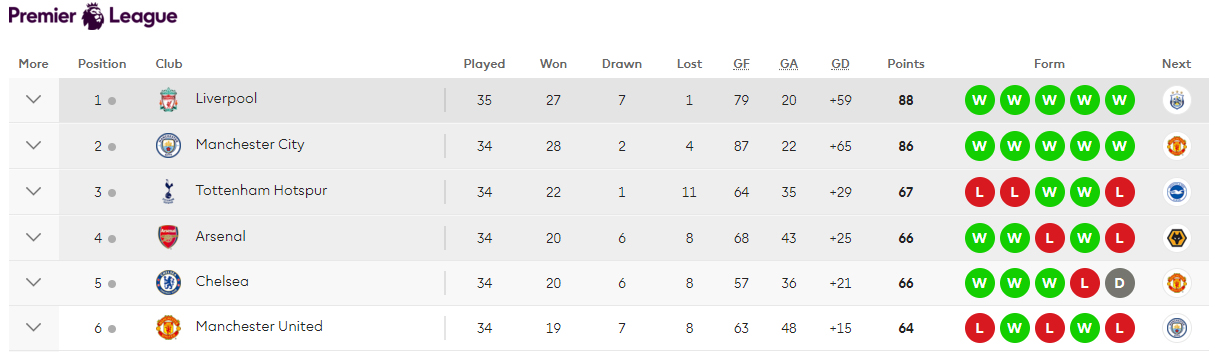
Battle for top 4 (www.premierleague.com)

In the Premier League, while Spurs dropped three points, this past weekend saw Arsenal lose 3-2 to Crystal Palace, and Manchester United lose to Everton 4-0. Additionally, Chelsea drew Burnley 2-2 on Monday, 22 April.

Four matches remain for Spurs, and three of those matches are at home (Brighton tomorrow, West Ham on the weekend, and Everton in the final matchday of the season). They will also travel to the Vitality Stadium to face Bournemouth. This is in contrast to Arsenal, who has only one remaining fixture at the Emirates (v Brighton, with away matches to Wolves, Leicester and Burnley). Chelsea, after their draw to Burnley, travels to Manchester to face Manchester United, and will host Watford and travel to Leicester. Manchester United has the toughest schedule, set to face City in the Manchester Derby, Chelsea and then relegation bound Huddersfield and battlers Cardiff.

An unexpected Champions League run to the semifinals against giant killers, Ajax, will also preoccupy Pochettino’s list of concerns in the final weeks.

What may prove to be Spurs’s undoing is the mounting injury list, which now features not only stalwarts in Kane and Winks, but also the versatile Sissoko, who Pochettino has concerns for after his groin injury in the quarterfinal. Hugo Lloris, also missed the most recent City match after a mild injury, and his status remains uncertain. Pochettino also will miss the service of star man, Son Heung-min in the first leg of the Ajax semifinal, as he is suspended (for innocuously tugging on De Bruyne’s shirt half way through the second leg of the quarterfinal).

The last month has provided supporters of Spurs with many incredible indelible moments that we will surely not forget any time soon. As with football and sport at large however, memories only remain forever lasting if the season ends on a positive note.

Much remains to be written, but given what is at stake for a Spurs club that has been playing an increasing number of important games in recent years, surely an exciting denouement is expected.

Jaideep Kanungo